The temperatures have been slowly dropping. It’s now around -20F , but luckily the winds have been pretty still. Usual wind chills are around -40F.
It’s been a busy week. Our winter-over alternate, Maclean, arrived along with the EHT folks. This brings the number of SPT’ers up to 10! We’ve done lots of trainings, including rebooting computer systems, swapping in backup machines and EHT overviews. We also spent a lot of time showing some of the new-to-Pole SPT’ers the ins-and-outs of the telescope.
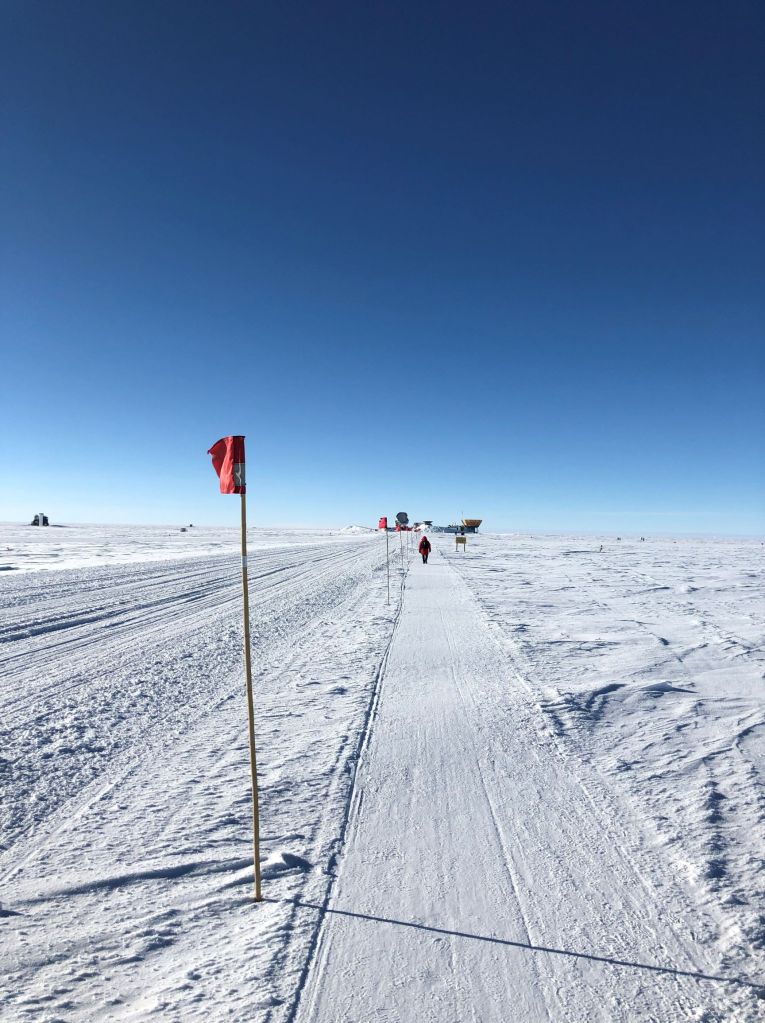
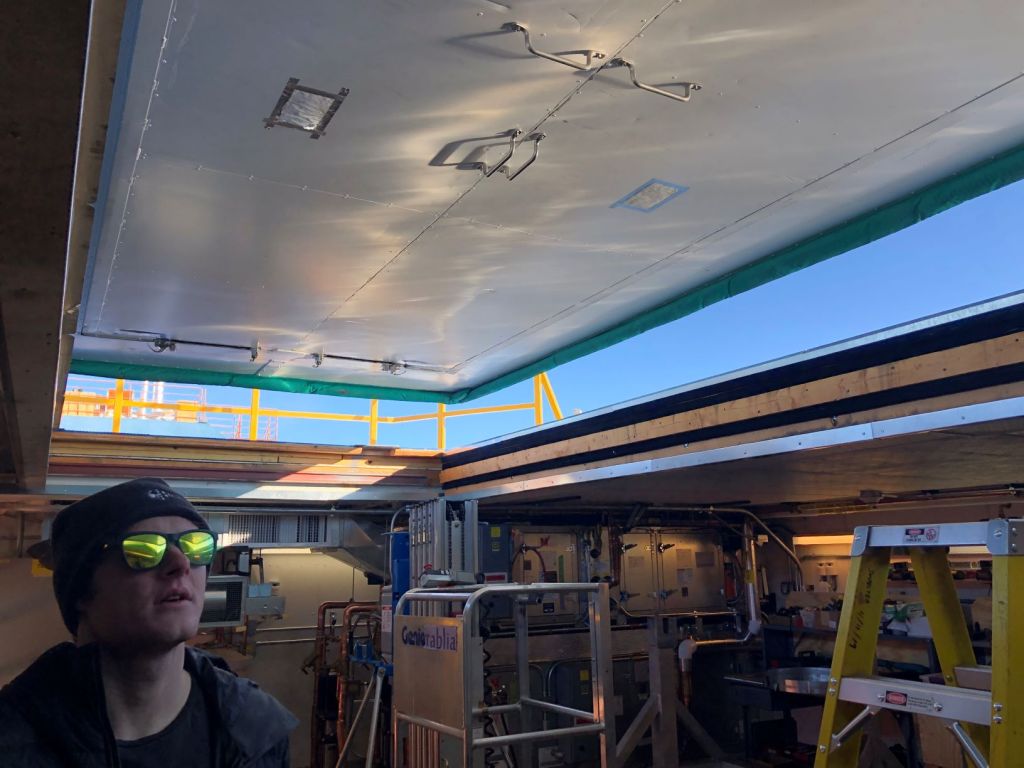
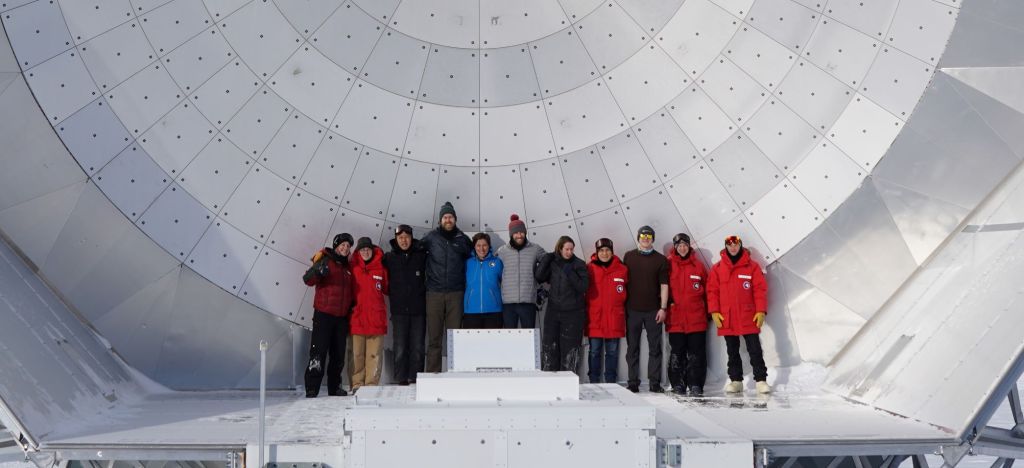
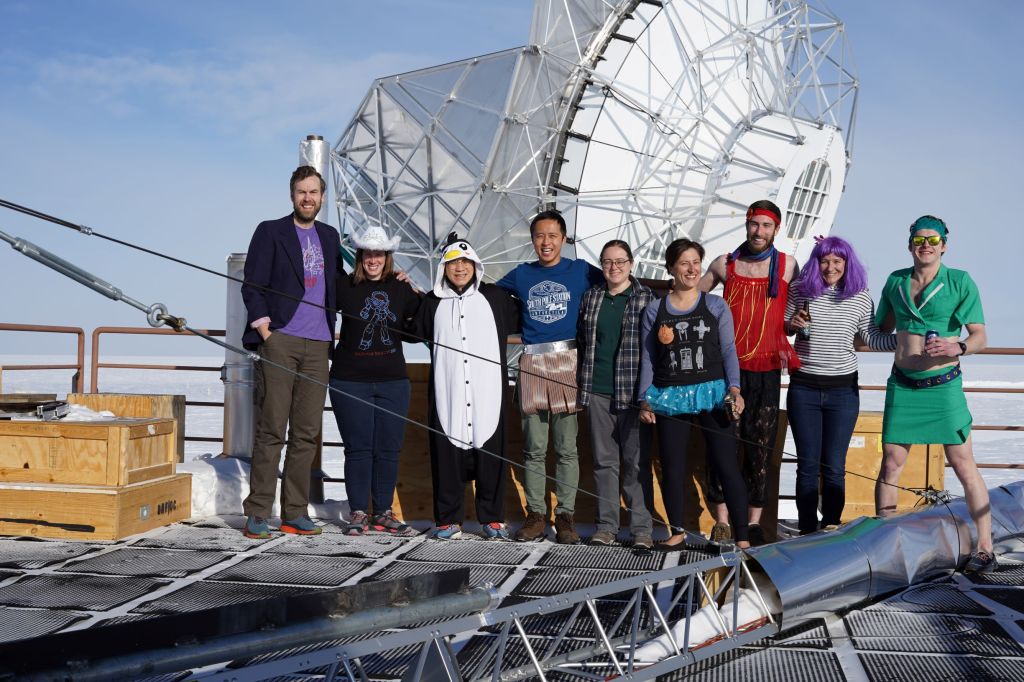
The daily walk to work. At the end of the summer we have a really nice walking path out to the telescope that makes the commute much easier.Me watching an un-docking of the receiver cabin from the building. The receiver cabin holds the cryostat, readout electronics and the secondary/tertiary mirrors. When docked to the roof, we can open the doors on the bottom of the cabin and climb into it to do any work that is needed.SPT group photo. With the sun shining on the dish, it actually gets quite warm up there in certain spots!
This week was also busy because we had to get ready for the South Pole Telescope open house/ wine and cheese party, lovingly known as Ladies’ Night. We estimated that this was the 10th almost-annual SPT Ladies’ Night, and is one of the most anticipated events of the year. We host telescope tours and slow dancing during the early parts of the night, and then a full on dance party later in the evening.
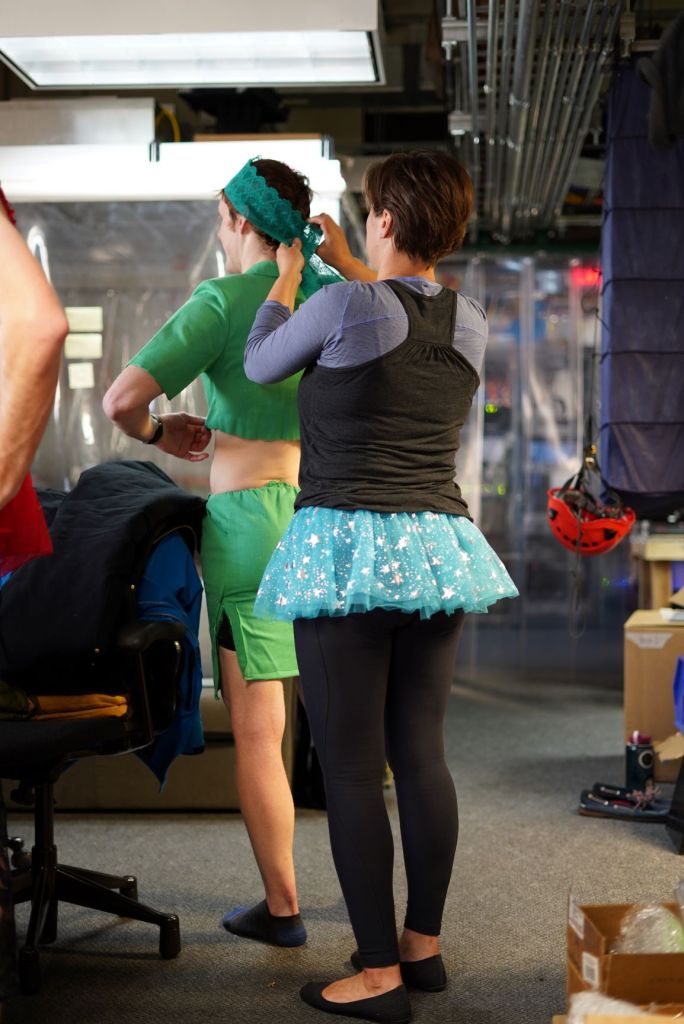
It is also encouraged to dress up for this event in some sense of the phrase… Some men on station like to wear dresses and there is a make-up get together beforehand. I had to scrounge around the skua shack to find something suitable to wear. I’m not sure I did, though. The only dress in there was far too small for me and I had to cut it in half just to fit in. I got a lot of comments saying that I looked like Peter Pan; so there’s that.
Preparing for Ladies’ Night, Sasha helps me with my headdress. I had found this dress (which was a one-piece, but didn’t fit) in the skua shack, where clothes are donated to the station. It is common for men to wear dresses to Ladies’ Night, as a bit of extra fun.The Ladies’ Night party hosts (SPT crew). It’s a little chilly up on top of DSL.
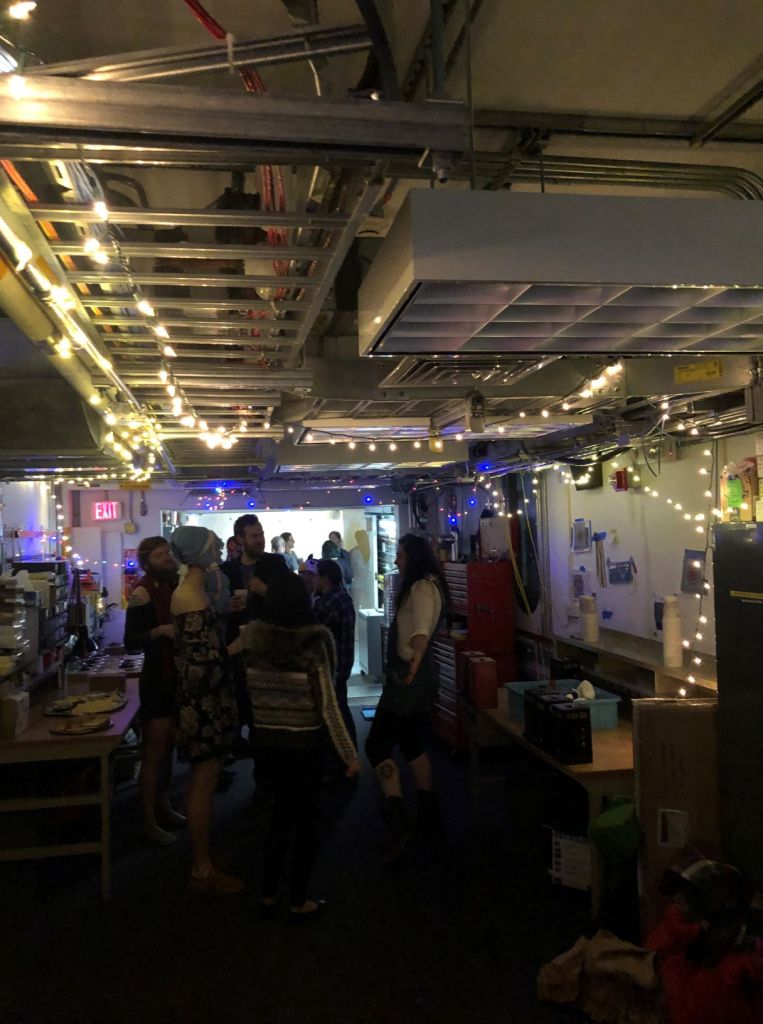
The transformation from lab space to party space took a few days, but it turned out really nice. The night started with telescope tours, including a nice open-roof viewing of some telescope scans.
Party-goers take a break to look out of the open sliding roof to watch the telescope scanning back and forth.
People then began to mingle outside of the dance floor, enjoying fine wines, cheeses and an impressive assortment of chocolates.
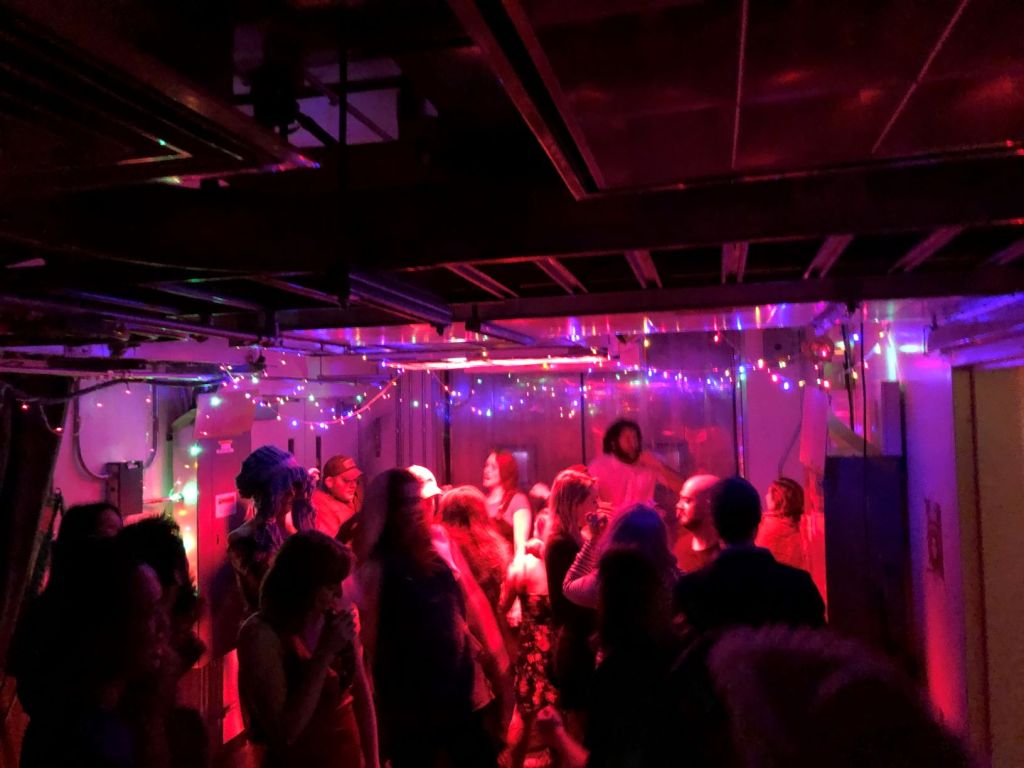
Bradford entertains guests as Sasha prepares to give a tour. This was early in the night, before the dance floor began to fill up, and before the bulk of the people had arrived.The Ladies’ Night dance floor in full swing. A cleared out loading dock and some Christmas lights make for a fine dancing space.
The night was a huge success, with lots of attendees and lots of dancing. Opening the roof and watching the telescope scan was a great spectacle for many people and they seemed to really enjoy getting up-close to the telescope. Ladies’ Night musical selection also went over really well, thanks to Brad’s DJing skills and an effort to select nearly all female artists.
There are only about 3 weeks left of summer. Many of the rest of the winter-overs have arrived this past week, and I think we start a winter-over team building session next week (or within the next two weeks). After the three weeks is up, we will be only ~40 on station for the next 9 months…. The past 3 weeks here have flown by, but I haven’t even been here for a month yet. Hard to understand what 9 months will be like. And then there’s the fact that it will be dark for 6 of those 9 months… weird.
A large, but thin cloud front rolled in. You could see it coming for a few hours over the horizon, like a slow grey tsunami wave. I don’t know the temps because my stupid browser wont accept the out-of-date certificate of the met’s webpage.. but it’s probably in the – teens.
The ‘South Pole Radio Telescopes’ tab observes the path out to the telescope that I walk on every day.
The carp party was a lot of fun. Unfortunately I managed not to take even a single picture :(. But I did get to toss a little Frisbee before the fire twirling started … I’m not sure what they call it, but there were two people who were apparently really good at twirling fire and gave a display to everyone. After that there was much dancing. So much dancing. Too much, some might say, and I didn’t get to bed until around 3am.
I also slept through a handful of pages from the telescope, but luckily some of the other SPTers were able to handle the problems.
Today, one of the members of EHT (the Event Horizon Telescope, which is a conglomeration of receivers at different sites around the world — one of them being the South Pole Telescope) arrived at Pole. Over the next few weeks he will be setting up the EHT receiver and training Geoff and I how to operate, calibrate and observe during the 2020 EHT observing run (likely late April, I think?).
Random thought of the day: As I was walking back from the telescope to the station, I thought about how different the walk is going to be in the dark. I kind of wish that there was a day/night cycle and that there wouldn’t be a few days of twilight so the change could be more abrupt. I imagine my mental idea of the South Pole will change greatly after the winter, and 6 months of darkness.
Random song stuck in my head: Travelin’ Soldier by The Dixie Chicks
Sorry I don’t have pictures or interesting stories to tell. I could bore you with updates on learning to rebuild computing machines, or how to track down bugs in the scheduling code at 1am when the telescope pages you to tell you something is f***ed up… but I think I’ll just let it go for now.
Weather today was similar to it has been; temps somewhere in the negative teens with a wind-chill near -40F, mostly sunny.
Today we updated the firmware of our readout electronics and are currently keeping a close eye on the telescope as we start our first observations. Dinner tonight was filet Mignon with asparagus risotto! mmm!
Tonight is the Carp Party, (hosted by the carpenters) which is one of my favorite on station because it’s a half inside, half outside party with dancing/food/beverages inside and outdoor games like ring toss, corn hole and some wood throwing game (? idk). I like having a bit of outdoor activities, especially on a nice day like today.
I brought down a black Frisbee for just this occasion!
Parties at South Pole are taken very seriously by the hosts. Annual traditions such as the carp party (and next weekend’s SPT Ladies’ Night) are sources of excitement down here, and no one wants to disappoint the station population. At Pole, the work week is 6 days, 9 hours per day for government contractors and generally 7 days a week for grantees (with wildly varying hours), so it’s nice to have a weekly event in which to relax and hang out with people outside of your department.
And with that – I’m off to the Carp Party – pics and stories to come…
Weather: Has been warm and moderately windy. Clouds gave way yesterday to one of the most beautiful, cloudless days I have ever seen at Pole, but today was windy enough for snow to be blown around giving the sky a cloudy/misty look. Temperatures around -14F with a windchill down near -40F.
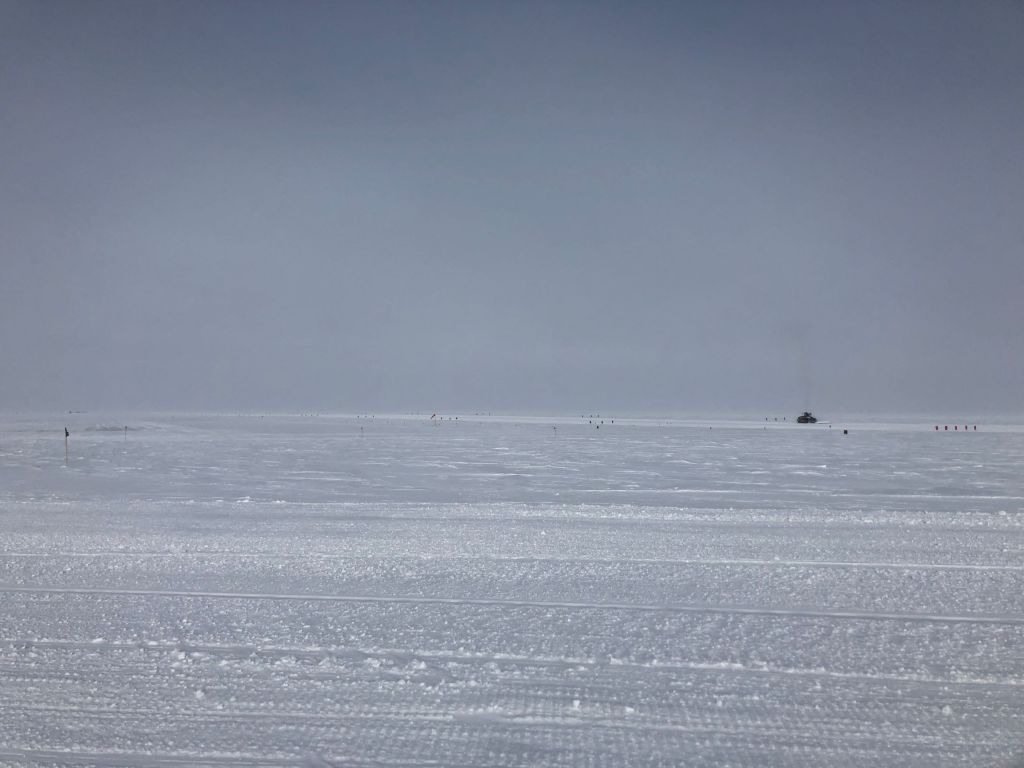
One of the cloudier days we’ve had. I ran out to our old polarization calibration source (basically a large piece of plywood with a reflective covering and a hole in the middle for the polarized source). You can barely see the SPT or station in the distance.
After a week of no flights to Pole, we got 2 in today! Nearly 30 passengers arrived on the first flight (with about 15 of those being winter-overs who were on R&R in McMurdo). Our other 3 SPT’ers also arrived after being delayed by about 1 week. Needless to say they were ready to get here!
A large tractor grooms the runway two days ago in preparation for the incoming flight (which was delayed another day, to today).
There has been a lot of heavy machinery activity around station with plows, dozers, snow movers and snow groomers all actively moving snow. This is all to get ready for winter; digging out buildings and leveling the snow so it doesn’t pile up. Even in the 2 weeks I’ve been here we’ve had 3-4 foot snow drifts around our outhouse and the entrance to DSL.
One of the large bull dozers digging out DSL. The treads on these dozers is about as tall as me! They have to move this snow each year so that the building doesn’t get buried during the winter.
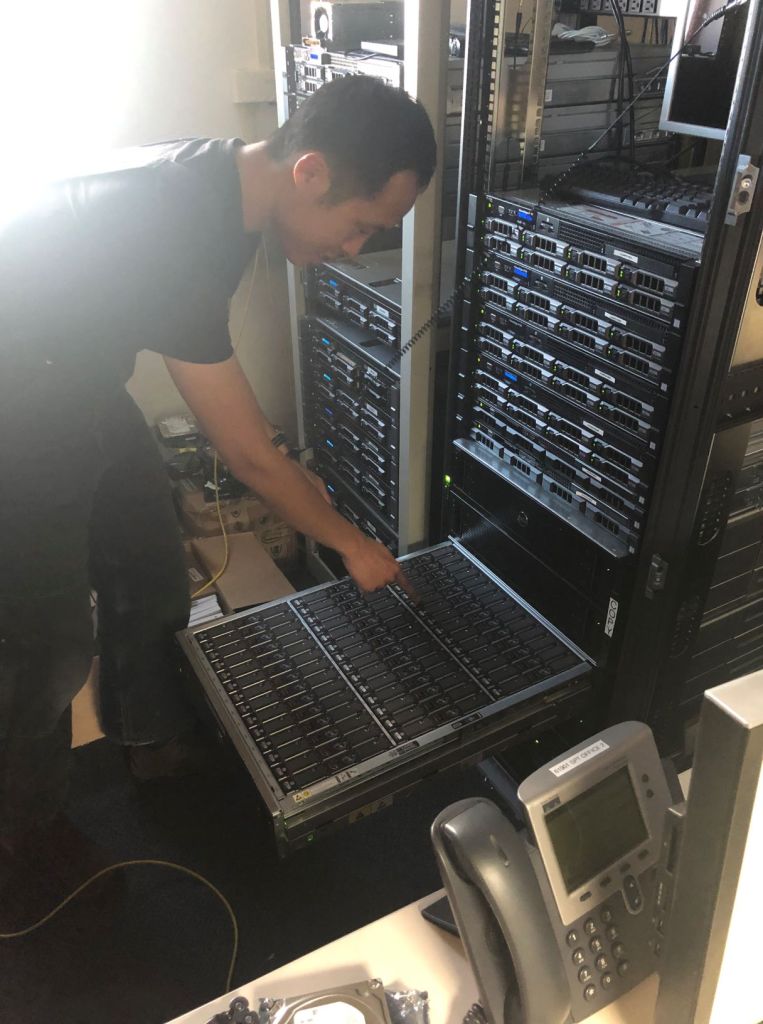
During the past few days we have been mostly concerned with how the 3rd generator will power the station; we have docked the telescope and were not doing any observing or moving (with the fear being that in the case of a power failure during scanning, the telescope brakes will engage and cause a hard-stop… which is not good for the building structure, let alone our sensitive camera). During this time we were able to do some computer replacement and also extract about 70Tb of hard drives containing SPT’s data from last winter. We will send these north as a backup hard copy since we’ve already sent most of it north via satellite.
During the time on Gen3, we had 3 brownouts. Each time some various components of SPT went down including some computing systems and a fridge compressor. This turned out to be really good practice for me and Geoff so we could troubleshoot what happens in power outages and how to recover.
We’re back now on Gen2 for at least 3 weeks and there should be a Cat technician coming to Pole soon (or was on one of the flights today?), to work on the generators and try to get all 3 up and running without problems. As of about 5 minutes ago, we started observing again. Weather is really nice, so hopefully we get decent maps!
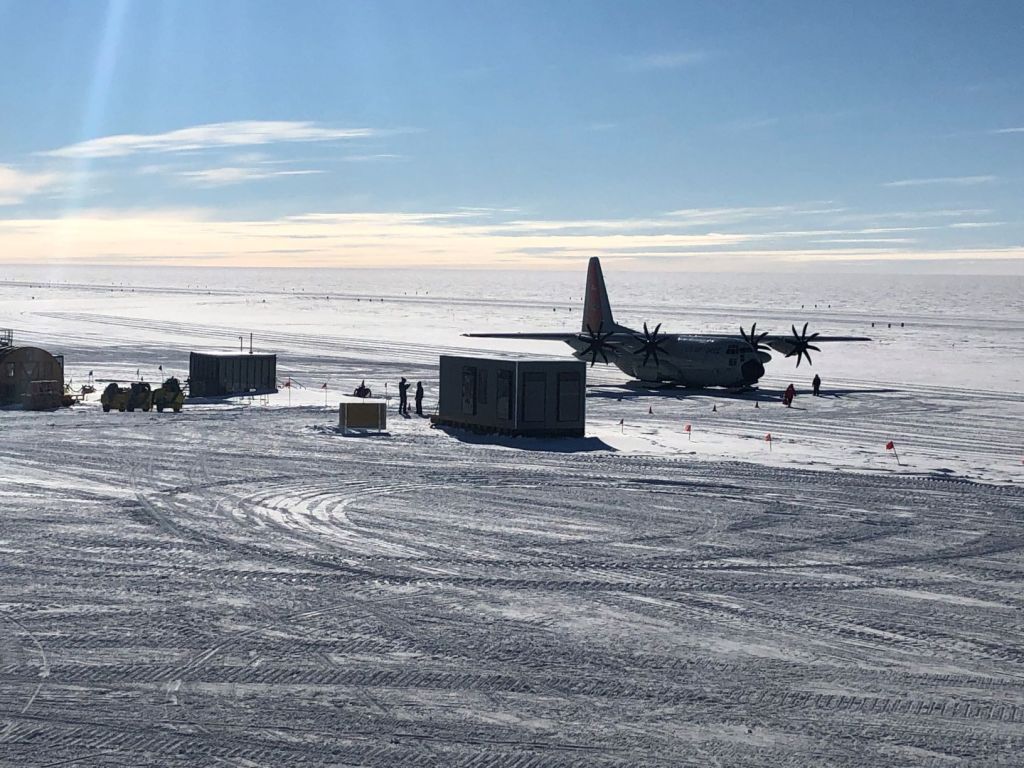
The first LC-130 in a week to land at Pole, bringing in about 30 passengers.
I took another running video, where I gave a quick tour of the facilities at Pole. It was complete crap, but hopefully I can learn the tools of the trade in video editing to provide some semi-interesting information in these videos. I still don’t know if I can reduce the resolution enough to upload them from Pole, but maybe I’ll build a bank of videos for when I get back to civilization.
Weather: Sunny, warm, windy. Temps around -14F, windchill -35F.
Today was a beautiful day. Clear blue skies and lots of sun! We spent most of today learning about the SPT computing systems and teaching the other winterover about the readout electronics and hardware. I think we scared him a little after we looked at the code that runs the automatic fridge cycling and readout tuning. Observing has been going smoothly and we haven’t had any unexpected errors.
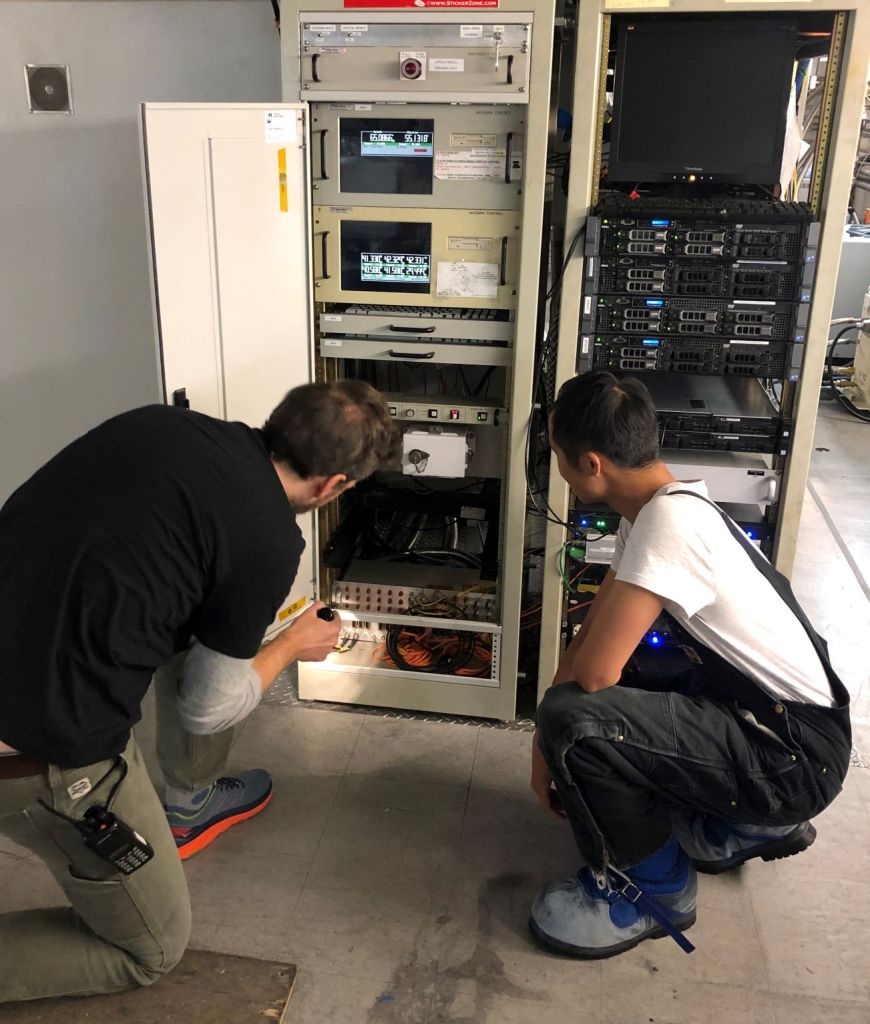
Geoff replacing one of our 8Tb hard drives in the storage rack.
Tomorrow morning, the station will be switching generators for annual maintenance. There are 3 generators on station; gen 1, 2, and 3; gen2 is the golden boy, which usually runs without giving too many problems but just needs it’s annual tune-up as far as I understand it. There have been some problems with gen3 in the past, causing power ‘burps’ and brownouts of some of our electronics so we are being cautious and halting observing tomorrow for a while while they switch over to gen3. They seemed to have solved some of the problems with gen3 so hopefully things will go smoothly and we can start observing again by afternoon, but this also gives us a chance to dock and get up into the receiver cabin; which Geoff has never seen.
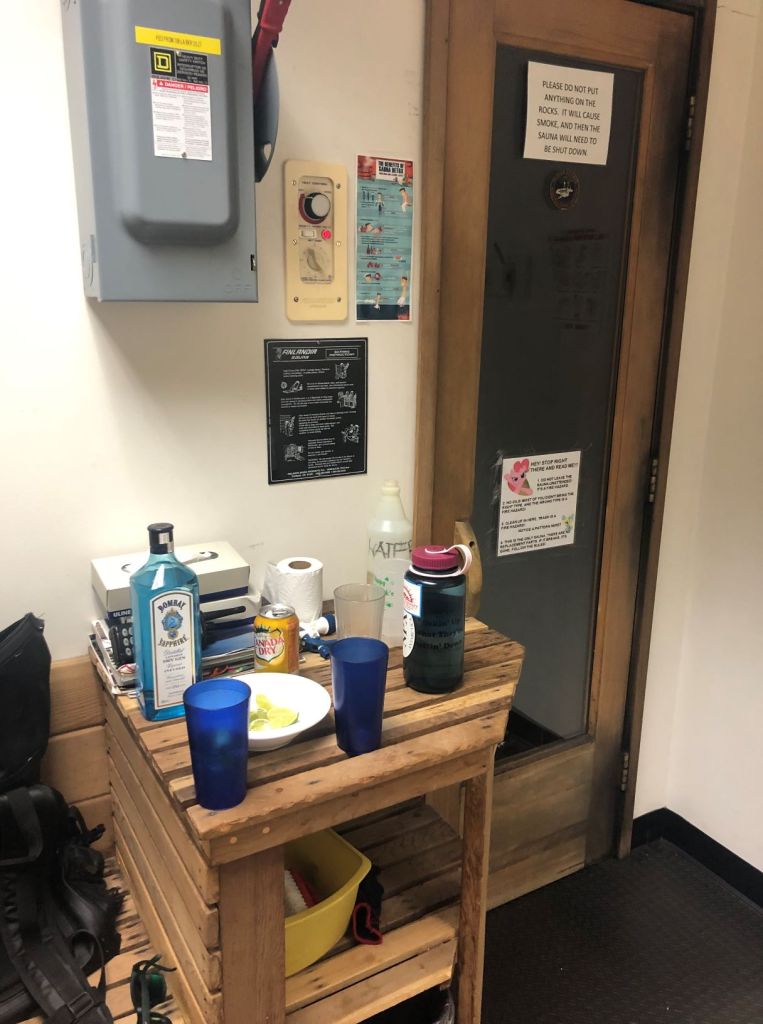
In other news, Sauna Sunday was a success! We didn’t do a Pole run but it was pretty warm out and not very windy, so the mini outdoor cycles were nice and comfy.
Gin and tonics; the perfect way to start Sauna Sunday!
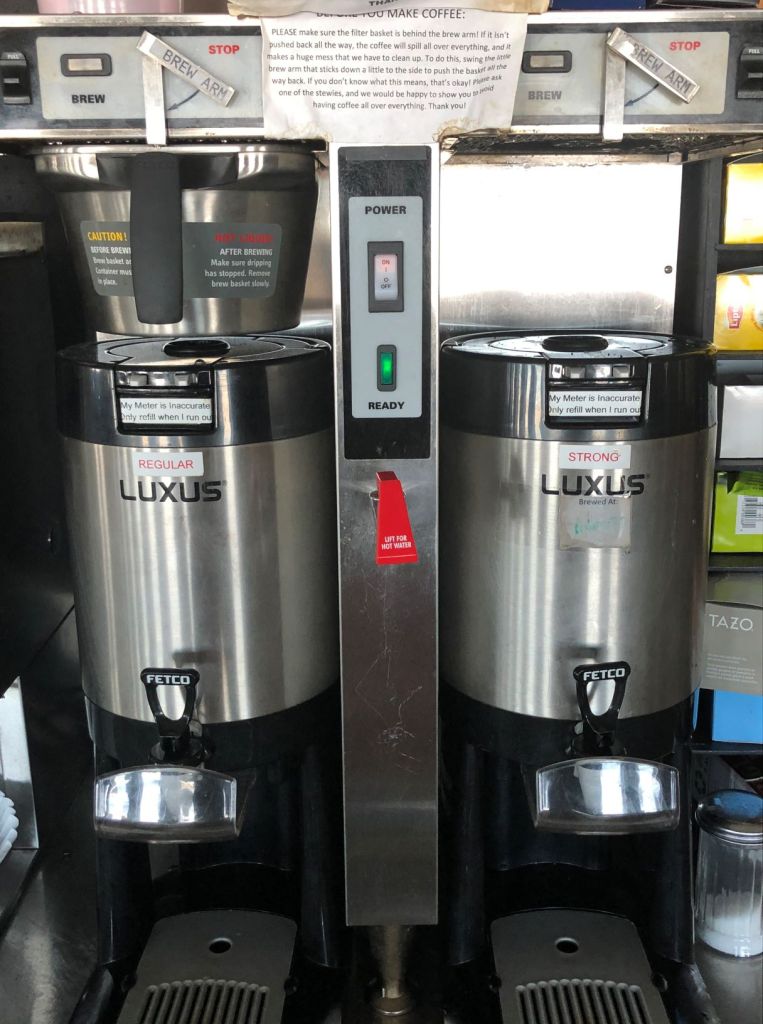
Something that really sums up life at Pole (or at least my life at Pole) are the coffee pots, which often run out at any time of day, and are labeled ‘Regular’ or ‘Strong’… no decaf!
Refilling the “strong” coffee… I probably do this 2-3 times daily. These coffee pots do not last long around here!
We hope for some flights to come in tomorrow and bring our other 3 SPTers from McMurdo. Their flight was canceled today, even though the weather at Pole was beautiful… I think they claimed it was a maintenance issue, though I had heard that the weather was pretty crappy in McM.
Weather: Warm, windy. Got up to the single digits today (negative, of course), but wind chill was down near -30 or -40 F.
Last night was trivia night. The SPT/IceCube team took 2nd place, just edging out the Bicep crew. First place went to a team of SPoT drivers (SPoT is the South Pole Traverse).
Today was pretty laid back. Sunday is everyone’s day off (though that doesn’t apply so much to grantees or galley staff) and there is brunch starting at 10:30am. Brunch is great – lots of yummy food that we don’t usually have – but it can also be tough because there is no lunch on Sundays. Brunch goes ’till 1 and then there’s nothing until dinner at 5… it’s a harsh continent.
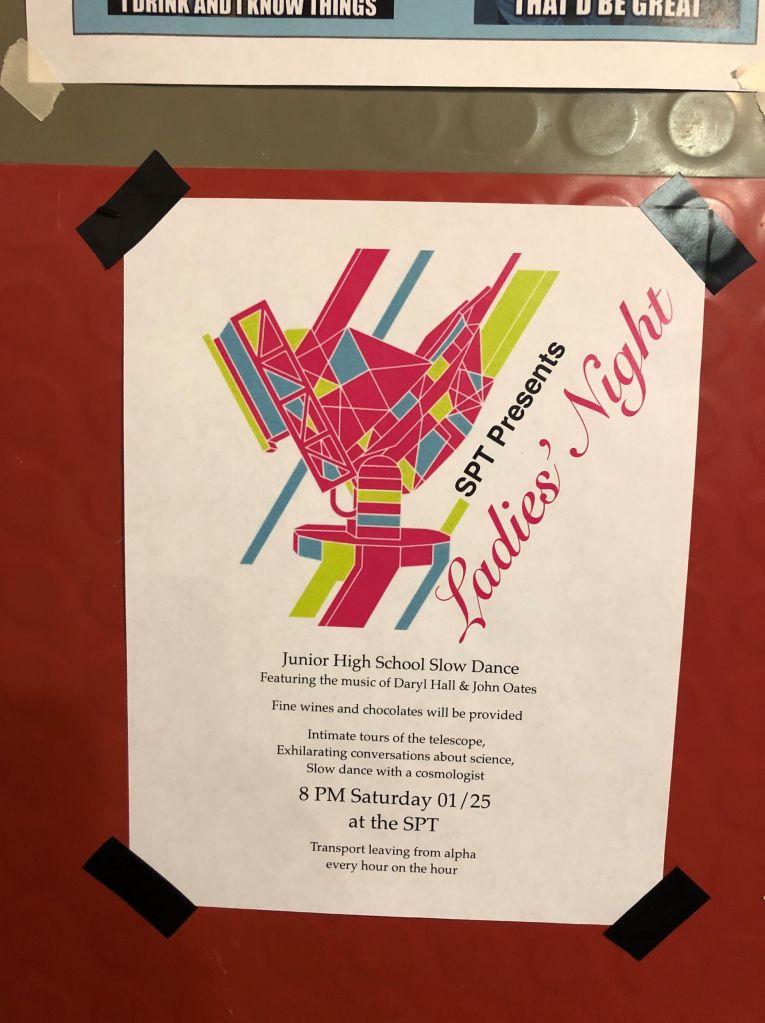
After brunch we went over some more winter-over training with Geoff including daily rounds and data quality checks. We also did some more cleaning of DSL; trying to make room for the SPT Ladies’ Night coming up in 2 weeks! Each group at Pole generally throws an annual party, such as the Carp party, Met party, etc. (carpenters, meteorology hosts them). The SPT Ladies’ Night is a nice change of pace from some of the other types of parties at the South Pole… just check out the announcement:
The annual SPT Ladies’ Night invitation posted on the activities wall in the station.
Since it’s Sunday, it’s also tradition to have SPT sauna night tonight around 9pm. I don’t know if I’ll do a pole run tonight, but will at least do a few mini cycles out back of station.
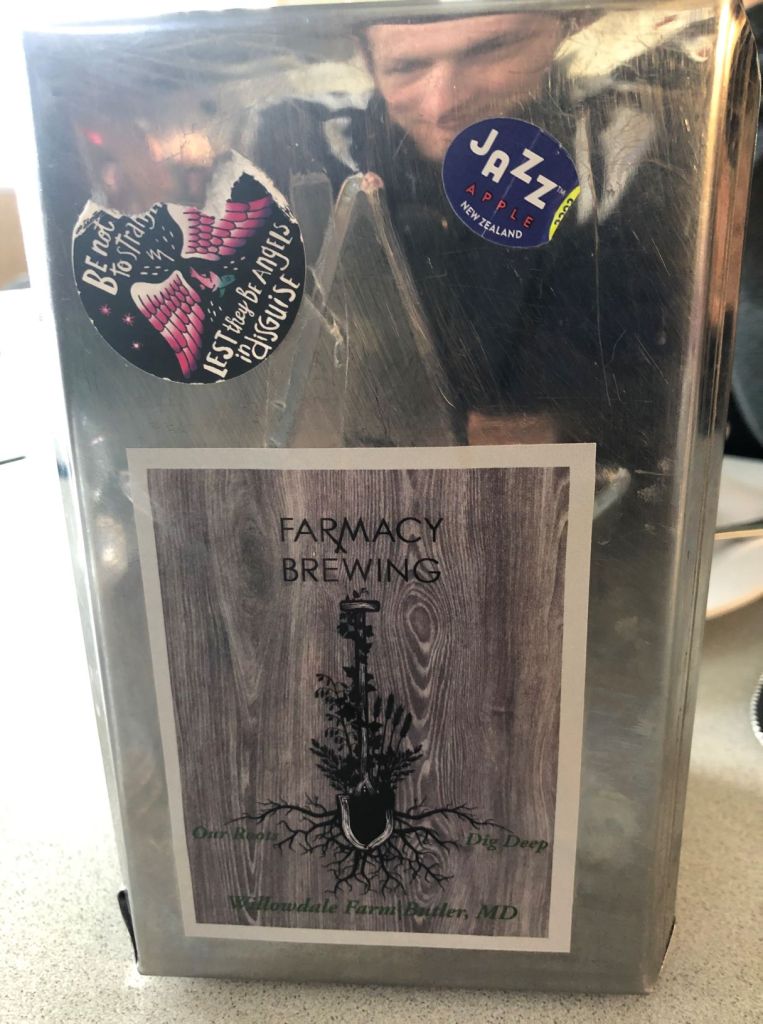
I also planted a sticker on one of the napkin holders (it’s no easy feat to find an open spot). There are a bunch of napkin holders in the galley, and it’s a popular tradition here at the South Pole to put stickers on them; usually of the Brewery or Antarctica variety. Cheers to a great up-and-coming brewery!
Weather: Pure crap. Windy and grey, blowing snow and low cloud shelf. Not good for observing. Temps still relatively warm, -12F with windchill down near -40F.
It was actually sunny earlier in the day, but has since gotten bad. No flights to Pole today, but hopefully the other 3 SPTers in our crew will be arriving in McMurdo shortly which would put them on a flight to Pole Monday (weather/mechanical/crew permitting).
We spent most of today showing Geoff, the new SPT winter-over, around the telescope and the Dark Sector Lab. Since he doesn’t work with SPT on a regular basis, he has never seen the inner workings of the experiment, so we also gave a lightning overview of the cryogenics, detectors and readout – all of which are important to understand during observing and for problem solving if things go wrong.
Brad explaining the drive system to Geoff. This is the main control panel for local control of the telescope.
I did some analysis today in the off-time while Geoff was setting up his computer accounts, etc. I may have to start boring you with my 3G data analyses if things keep running so smoothly.
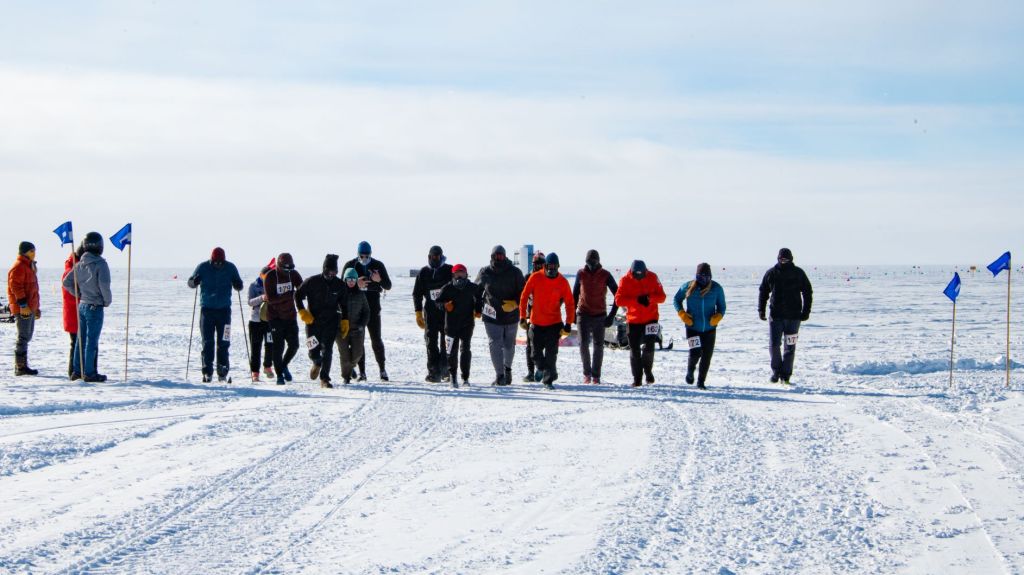
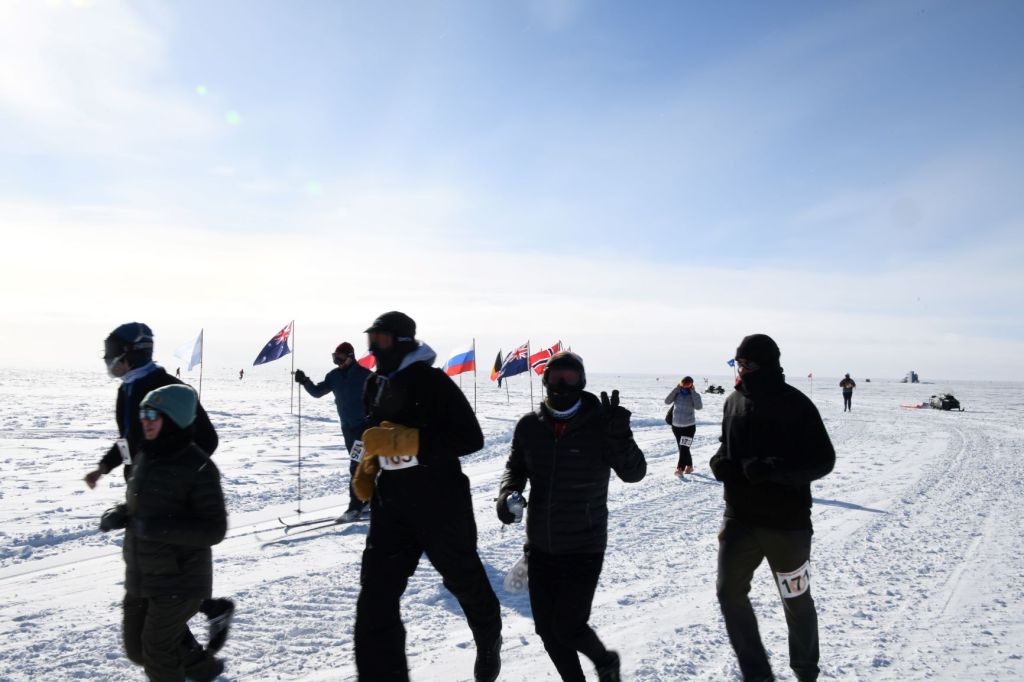
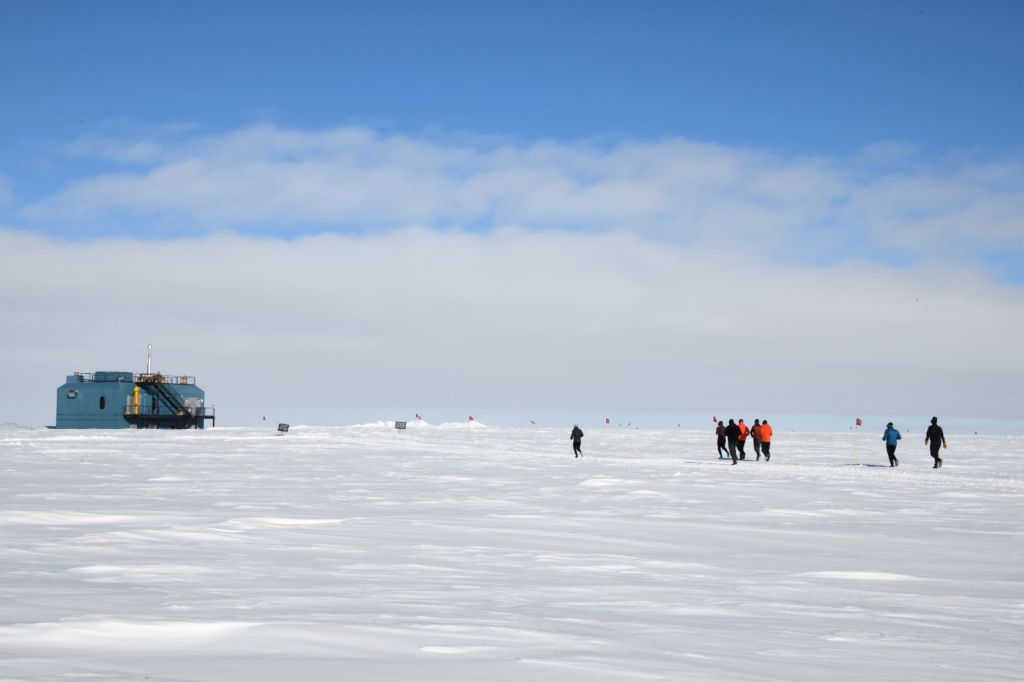
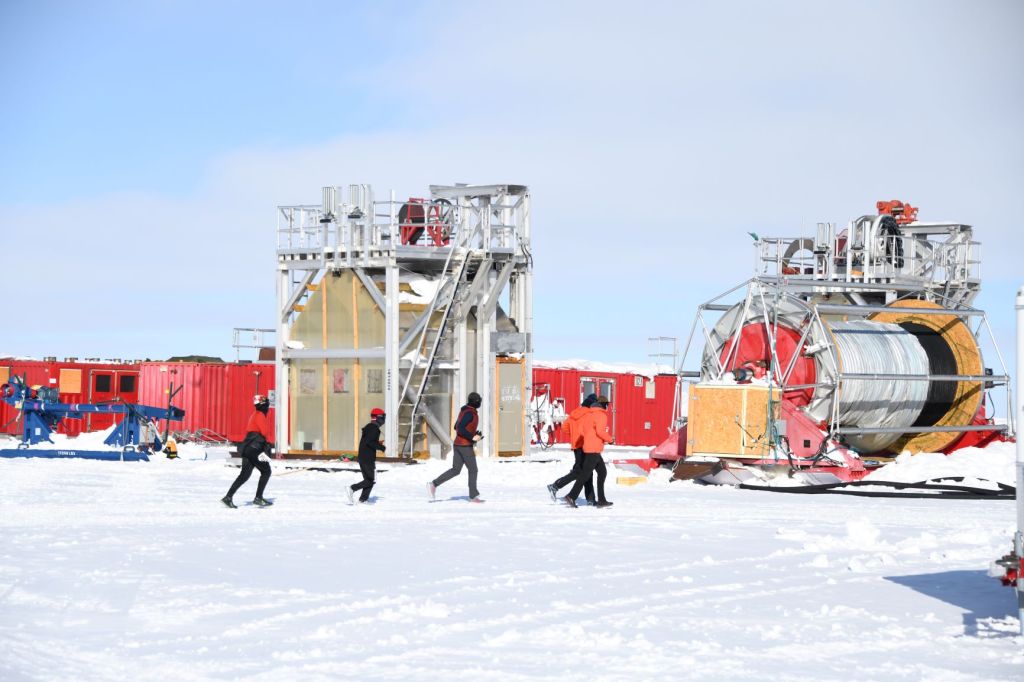
Marathon:
I got the pictures from Yuya (one of the IceCube winterovers who took pictures during the race). They are all super nice, high resolution photos, so I can’t do them justice by uploading them here but I will upload some downgraded pics here.
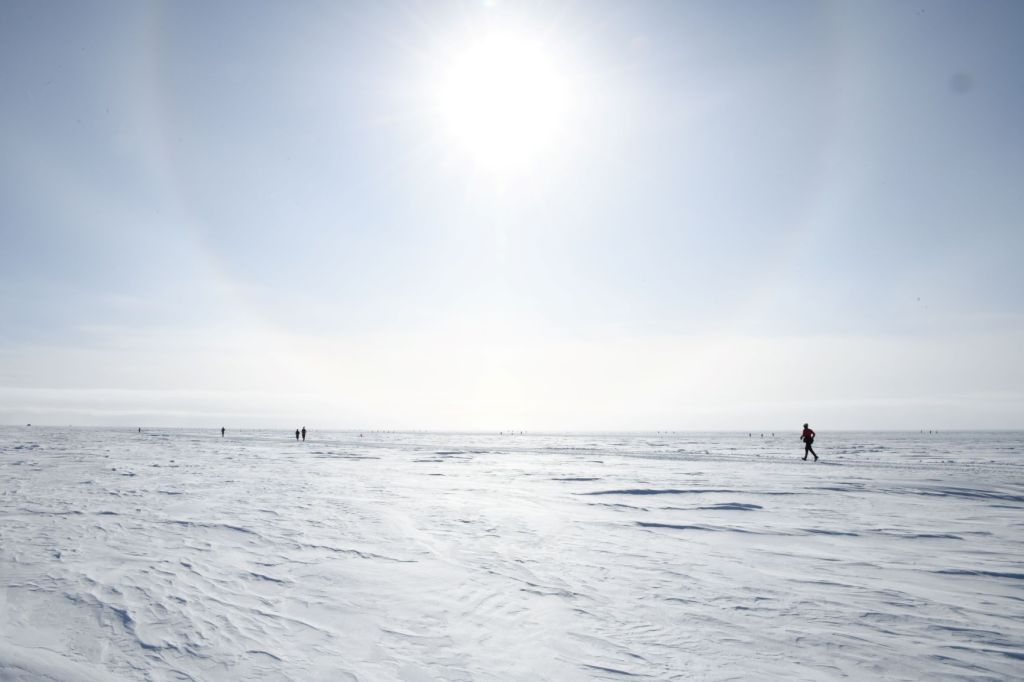
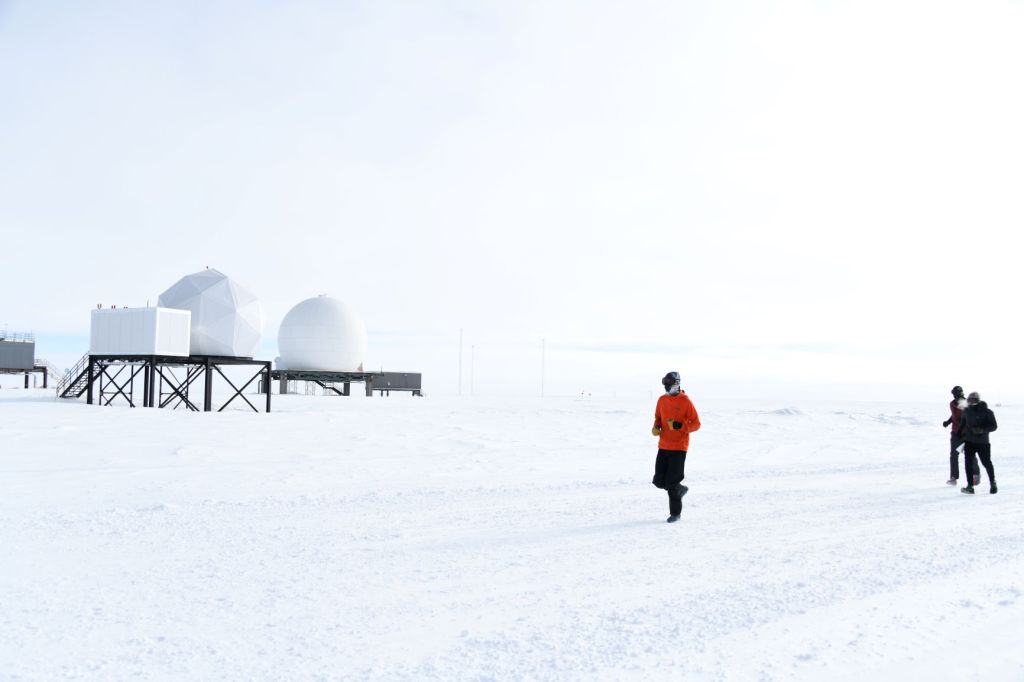
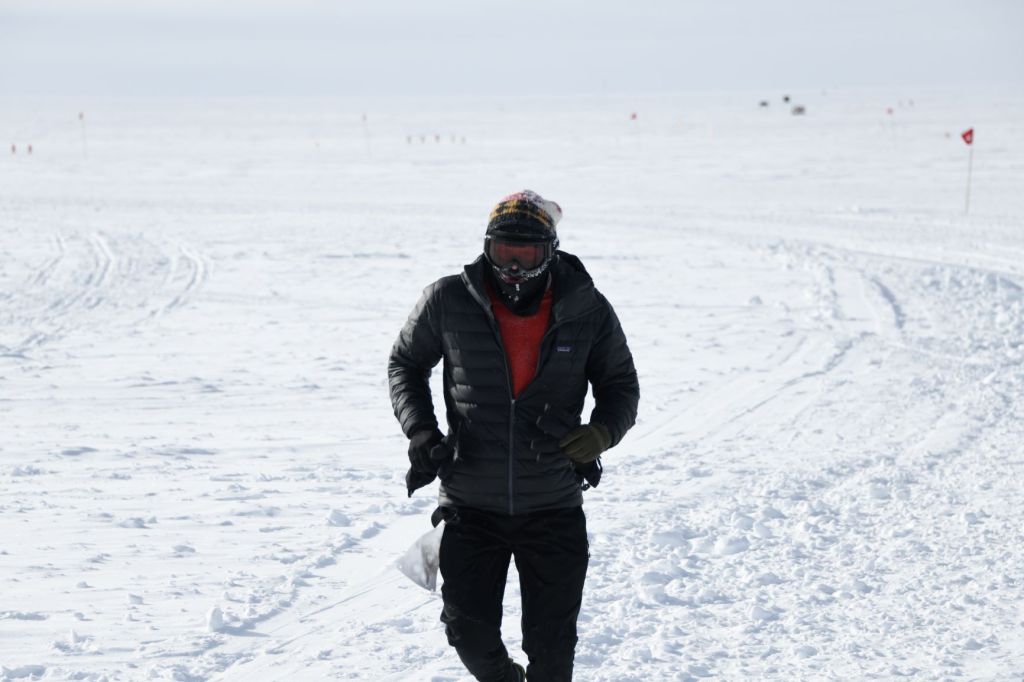
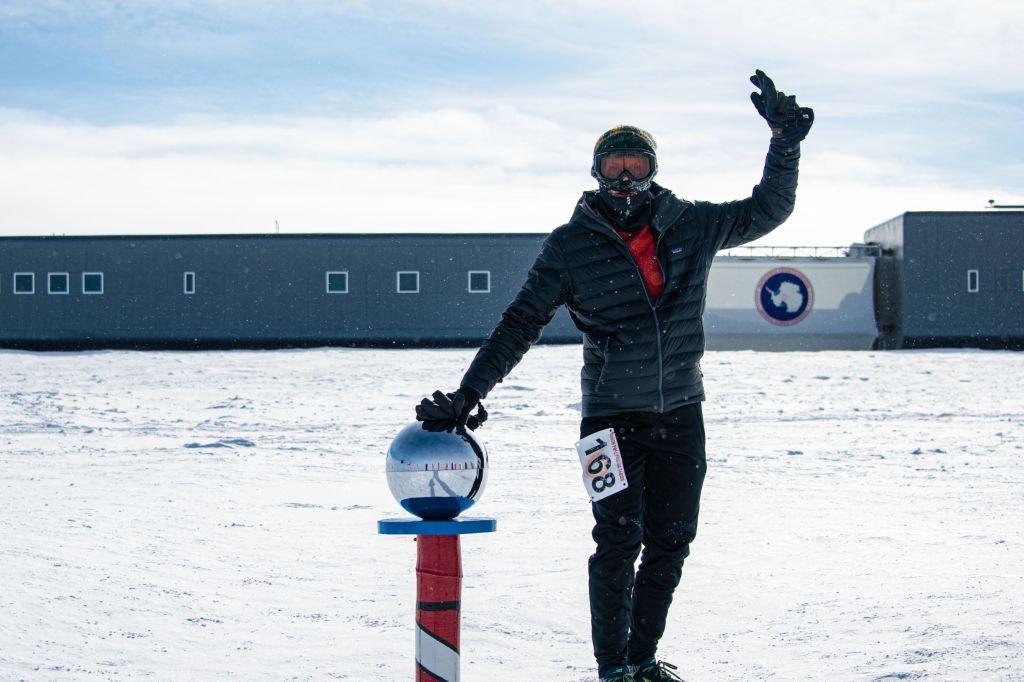
Starting line of the 2020 South Pole Marathon… You can see my MD flag hat in the very back… I had thought I would bring up the rear in this race, so I started in the back. Photo Cred: Yuya MakinoOff the starting line — ceremonial pole is always the start/finish of races here at the South Pole. PC: Yuya MakinoAbout 2 minutes into the race… the marathoners were really pacing themselves. I guess I didn’t get the memo. PC: Yuya MakinoRunning past the old IceCube drilling rigs in the back of the berms. We were running with the wind, so it gets pretty warm. It’s important to thermo-regulate so you don’t sweat too much, otherwise it freezes. PC: Yuya MakinoEveryone trying to catch Kendl, the outright winner of the marathon. She would even beat my half marathon time, and go on to win the full marathon with a time of 4:33. PC: Yuya MakinoRunning down the side of the runway… and it was a good thing we didn’t use the actual runway, because a Twin Otter landed while I was down at the end. PC: Yuya MakinoTurn around at the end of the runway. I had gotten a little sweaty, but now I would be running back, into the wind. This is when the pants freeze! PC: Yuya MakinoRunning by the communications domes. Can you spot the interesting feature of this photo?? — You can see my breath. That is because the snowmobile that Yuya (photographer) was driving was parked upwind and the exhaust allowed my breath to condense. PC: Yuya Makino Riding the struggle bus to the finish. Some of the course was not very well groomed, which made it a bit like running in wet sand; slow going and tiring. Luckily it also makes it a little better on the joints, though my IT band was not happy during the last few miles. PC: Yuya Makino The finishing point of the 2020 South Pole (half) Marathon. I was very happy to not be running the full marathon! Photo cred: Yuya Makino
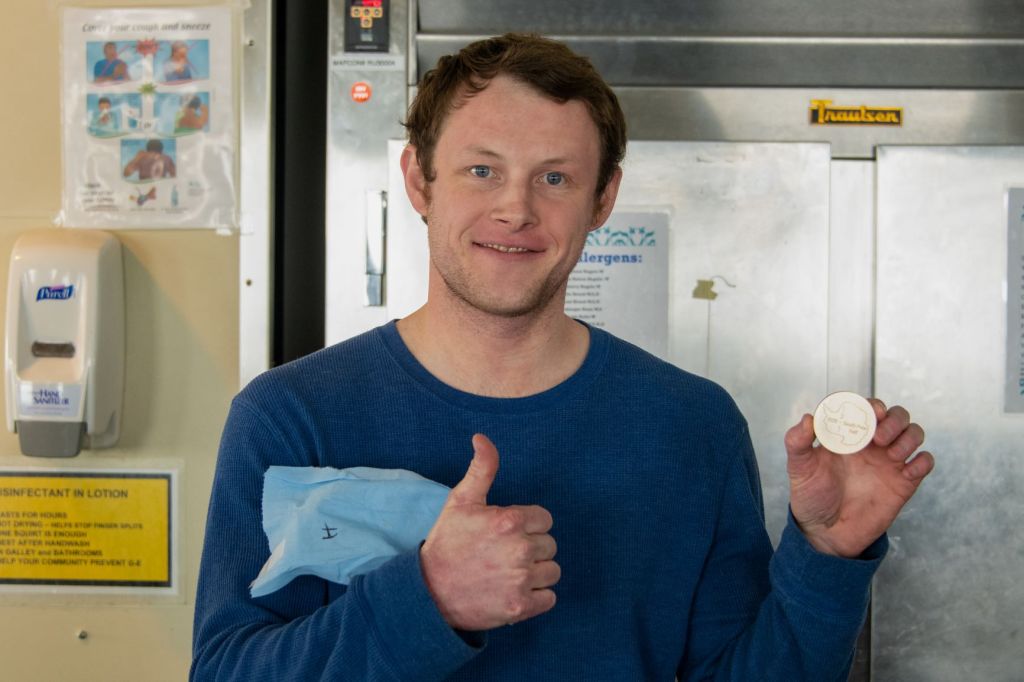
Post-race medals! A very nice touch, thanks to the volunteers and the machinists. Photo Cred: Yuya Makino
There ya have it. All of these photos I reduced the resolution by about 10x to upload them so you’ll have to wait ’till I’m back in the real world to see the full res photos. And some of them are pretty spectacular!
Weather: Colder today, mostly because of higher winds; Temp about -18F, with wind chill of -40F. Weather was mostly sunny.
Yesterday, a flight full of pax headed north from South Pole boomeranged back to Pole due to weather in McMurdo. This is quite unusual since there isn’t an LC-130 maintenance staff/ facility here at Pole, and it’s a lot colder. Fortunately its been pretty warm, with temps around -10F, but it’s still really unusual, and the flight was full of winter-overs trying to take their “R&R” (rest and relaxation) in MCM.
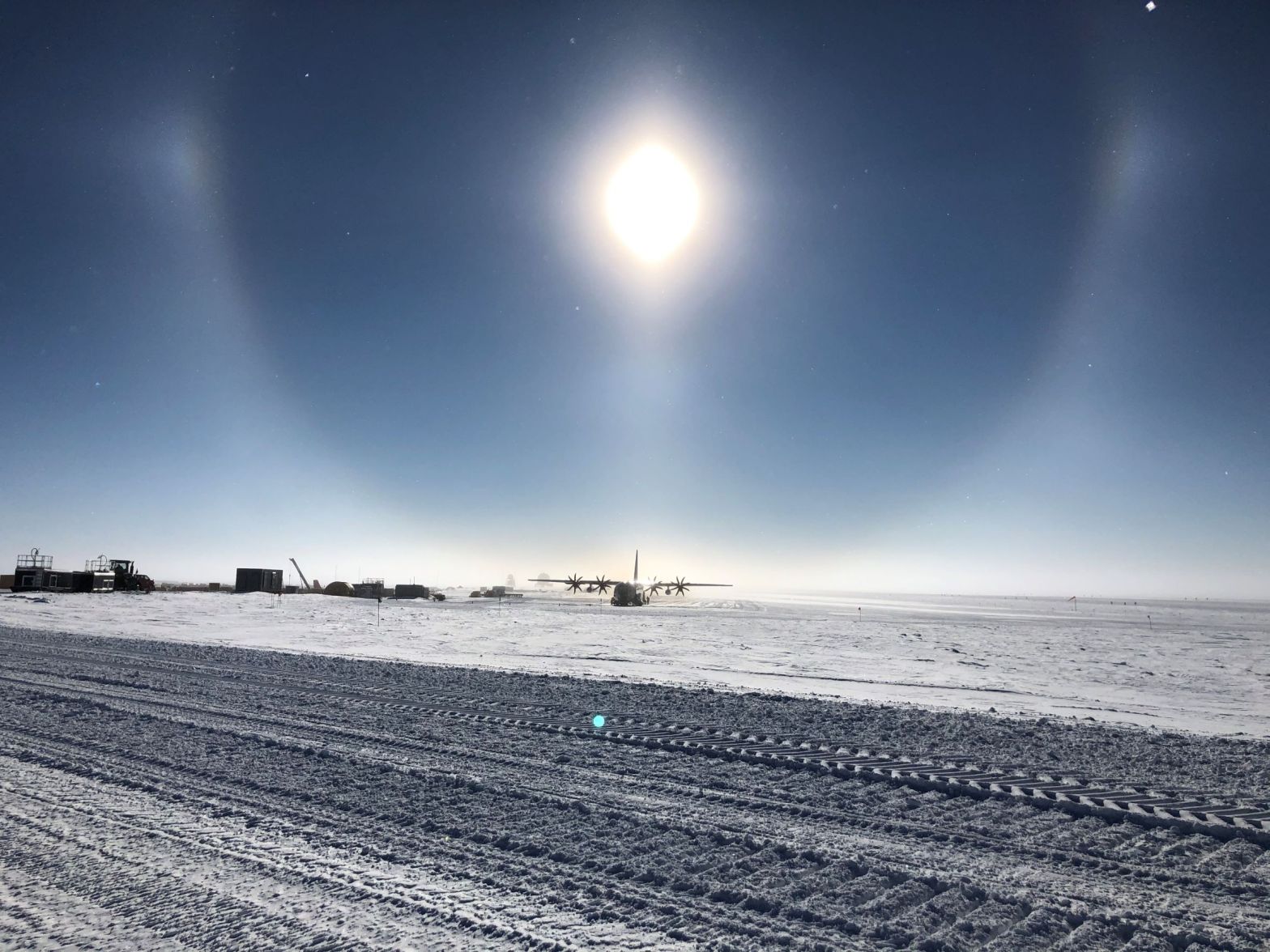
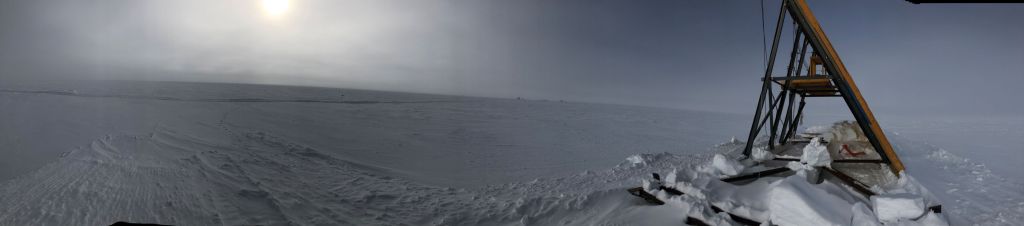
An unusual sight at the South Pole; an LC-130 sitting at the terminal, powered down. After the flight boomeranged, the weather at Pole got pretty bad, and even snowed a little bit. I took this picture walking back from the telescope; the horizon is nearly invisible and there is no contrast making it hard to see features on the ground.
The plane then took off this morning and seemed to start up fine, so everything went about as smoothly as it could have (and the weather cleared up, so it was sunny and not super grey).
Boomeranged flight leaving this morning under sunny skies. The color scale of this photo got ruined because I have to reduce the resolution to upload it.
Today, 3 of the 5 SPT’ers scheduled to arrive this past week have arrived, including the other winterover, Geoff. Tomorrow we will begin training him, and next week we will likely get into the deep dark depths of the computing system here at Pole since Judith, the computer expert, arrived today as well. It turns out that we have a pretty complex computing system which not only monitors the telescope but also does automatic analysis, and controls the distribution of data north/south when the satellites are up.
I have now been at Pole for 1 week… which is weird. I can’t tell if it seems like a long time or no time at all. I think I’ve learned a lot and am feeling pretty confident that things are running smoothly, but I know that the hardest part is to come — the computers! I don’t know nothin bout no computers. But hopefully it will make more sense after the next few weeks and repeated instruction.
I haven’t gotten many of my mailed packages yet, so I’m hoping those will come soon. One such package contains my bodywash and another my shaving cream… sooo yea, that will be nice to have.
I took a short ~10 minute video of walking out to the telescope from the station yesterday, but even after reducing the resolution from 4K to 780p it’s still about 2Gb… and according to Google Drive’s upload monitor, it will take upwards of 15 hours to upload… which just wont work considering the sat window is about 4 hours. I will have to find another way…
Weather: Warm, the day started overcast, but became a beautiful sunny afternoon. Temps around -12F with a slight breeze.
Summertime temps got me feelin good. I could even walk out to the outhouse without a jacket on!
Today I got my first little taste of operation complication. We have a lot of electronic pagers set up to automatically check that things are operating as expected. If some measured value goes out of a certain range, or some piece of equipment is not communicating with the computer system, we get paged on our radios (and emailed, and called in our rooms… etc). This effectively helps us constantly monitor the telescope operations without having to sit in front of the computer screen or in the control room all day.
This morning, as our fridge cycle was finishing up, and our scheduler was about to begin an observation, we got a page. The pager system doesn’t currently relay any message; it just calls you, so we ran into the science lab and checked the pager log. “DAQ not running”. This was my first opportunity to problem solve! DAQ not running means that the data acquisition software wasn’t running (or that it couldn’t communicate with the readout electronics). It was easy enough to find out that there wasn’t a DAQ process running, and that all of the readout electronics were ping-able, so it was clear that something weird happened which caused the DAQ script to die before it even got started. The fix was simply rerunning the DAQ script. Woo! First crisis averted.
After the fun learning experience, I began going over fridge cycles with Brad. Our detectors are cooled to a fraction of a degree above absolute zero, and in order to do that, we have a fancy fridge which uses He4 and He3; boiling and condensing He as a way to extract energy. This fridge needs to be ‘cycled’ in order to get back into the state where it can use it’s thermodynamic magic to cool the detectors down to .3K.
Fridge cycle fun! There are lots of different steps to cycling a He10 fridge with lots of pumps, heaters and other shenanigans. Fridge cycles take about 3 hours, and then we wait another ~2 hours for the detectors to cool down to their operating temperature. This cycling is effectively down time for the telescope because we can’t observe when our detectors are warm.
After discussing fridge cycles for a while, we went out to DSL and I performed the daily rounds. I promptly discovered that the boiler was not running, and that there was a low-fuel alarm light on. After calling the facilities folks, and switching to the electric boiler (apparently there was a fuel pump problem), I helped clean up some old pieces of equipment from the DSL building, and get them ready for retro; which means boxing them up to send back to the US.
Other fun things: the BICEP Array experiment is installing their experiment (with a fancy new 3-axis bearing).
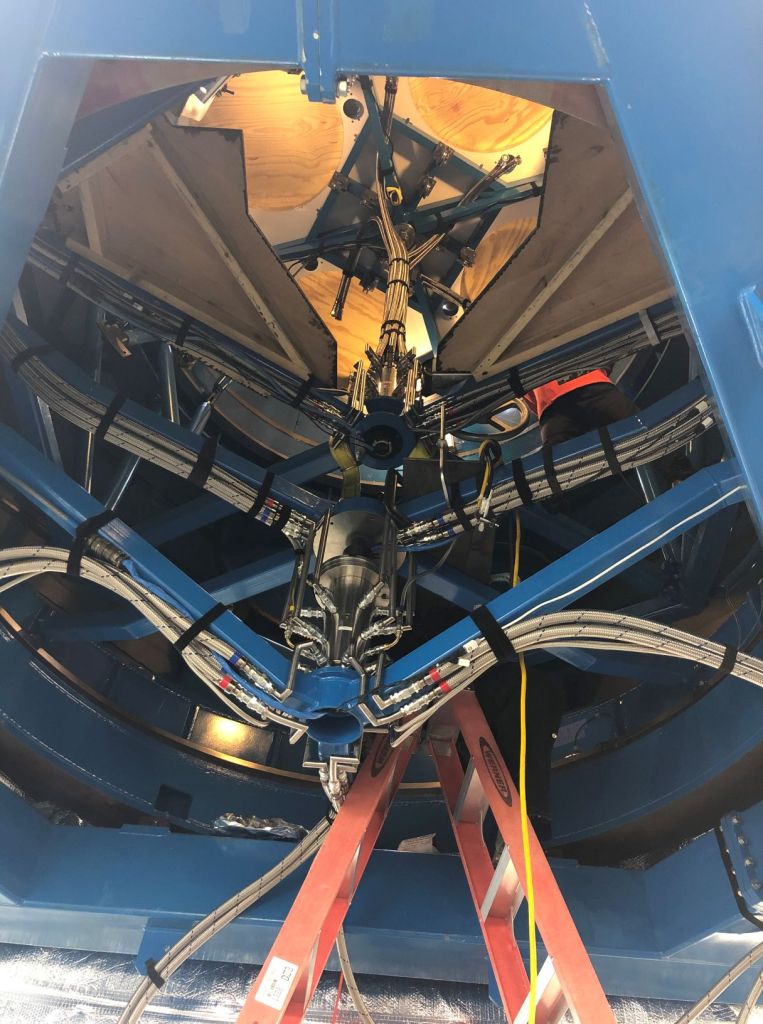
Part of the Bicep Array mount being lowered with a Mantis crane. Apparently there was some unexpected friction in their azimuth bearing which needed to be lifted and inspected (happening in this image…). The ground shield prevents me from getting any kind of interesting photo.Inside the Bicep Array receiver room. The blue structure is the 3-axis mount, which will house several large cryostats (similar to the size of SPT3G’s optics tube). You can see the circular plywood panels covering the holes where the tubes will sit. There is a really cool rotating cryogenics coupler that I don’t understand, and a person working up there for scale. This image is looking up from the blue building below the large ground shield in the previous picture.
Remember when I said yesterday that I had taken a video running around the Dark Sector and given a nice tour… well somehow that microSD card got corrupted, so I basically just ran around and talked to myself for 20 minutes for nothing! Oh well, plenty of other opportunities to try.
Weather: Beautiful sunny day! Very little wind; slightly bizarre how still it was today. Some high, wispy clouds at times.
Temperatures: Warm, around -10F .
Today I learned what to check during daily rounds. Each day one of the winter overs will have to go out to the Dark Sector Lab (DSL), where SPT is located, and perform rounds. These include basic checks that the heat is on, and that the glycol heating/cooling system is operating as expected. Similarly we have to do preventative maintenance on the telescope, such as greasing gears and bearings, clearing snow, and keeping the electronics happy.
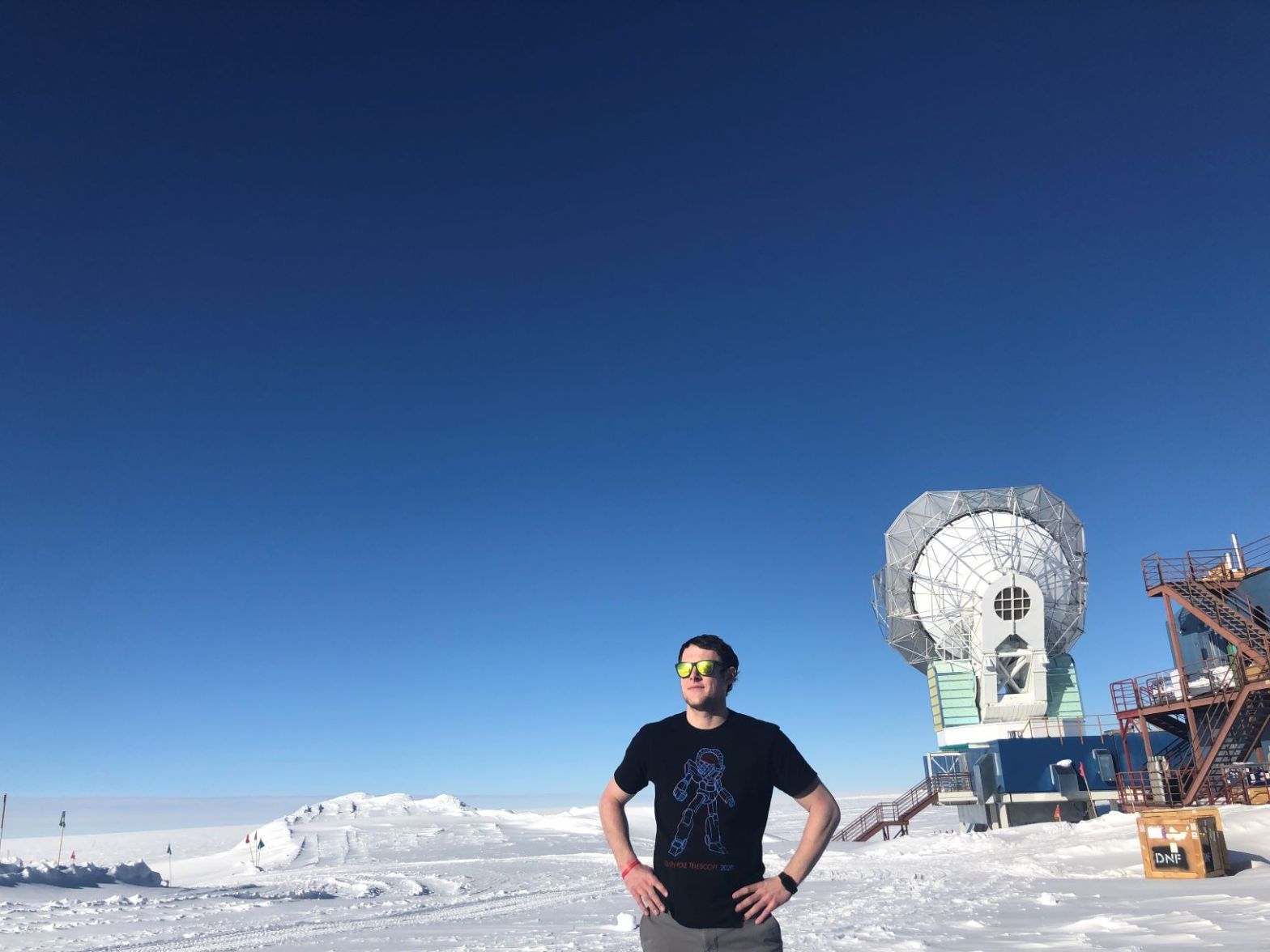
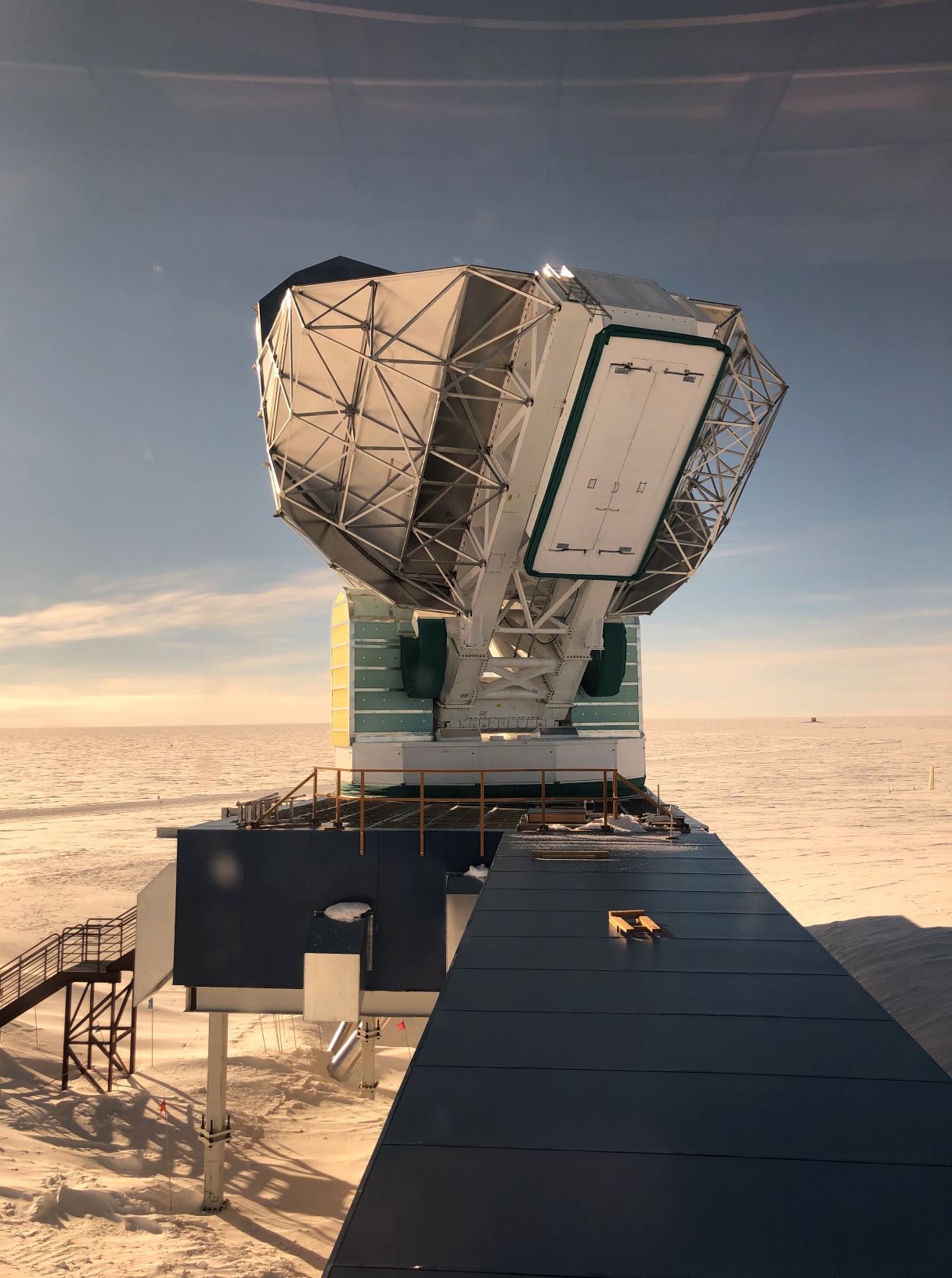
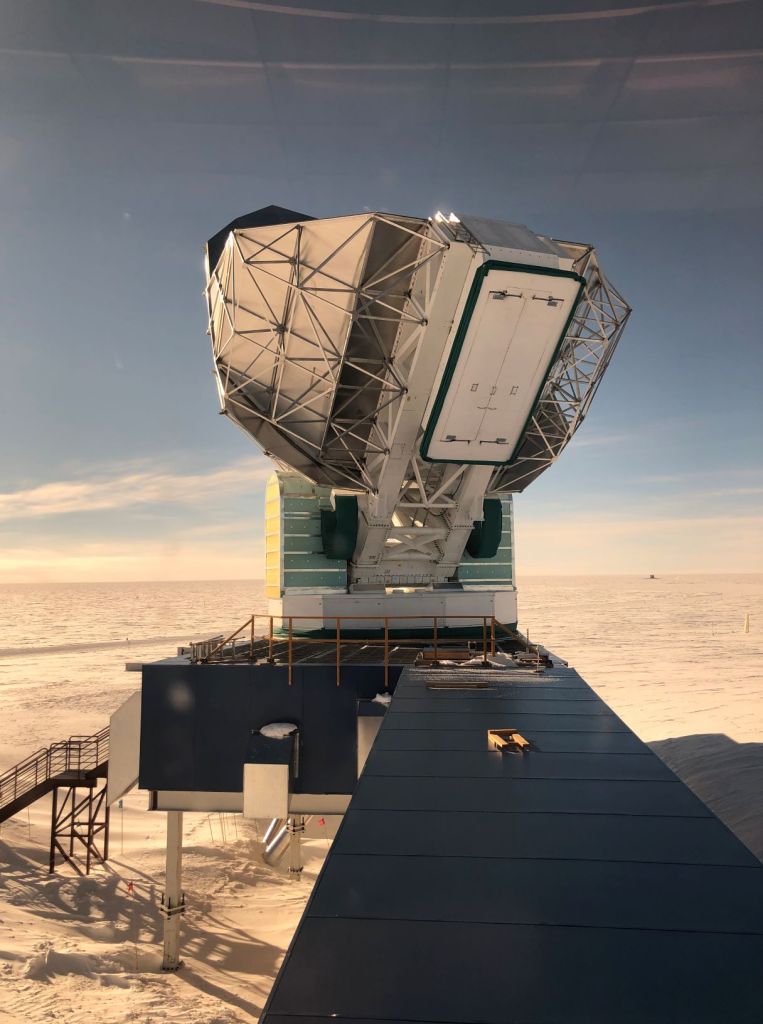
SPT from the 2nd floor of DSL. The white rectangular box with doors at the end of the telescope boom is the “Receiver Cabin”; a room where the receiver (the camera) is held. All of the readout electronics are also located in this cabin. The drive system for the telescope lives in the blue building underneath, called the “Control Room”. The telescope is designed to be able to dock to the control room, which has a sliding roof, and then we can enter the receiver cabin from the control room below.
Another important piece of preventative maintenance is just getting used to nominal operations, sights, sounds and typical actions that occur. For example, the electronics and cryogenics for the receiver have to get from the control room up into the receiver cabin, and have to be able to rotate with the telescope as we move around and observe. These cables, wires and tubes are wound up in what is called an “Az Wrap” (short for azimuth wrap, since this device wraps up the cabling as the telescope rotates in Azimuth), and then sent up through the rotating roof into the green cable sleeves which allow for slack when moving in elevation. We need to check that these cables are all in good shape with proper abrasion relief.
The az wrap, underneath the telescope. Cables are wrapped up in this spring-like contraption which tighten and expands as the telescope rotates around in azimuth. There are software and hardware limits which prevent the telescope from over-rotating in one direction and tearing these cables apart. Teflon sheets are used to prevent abrasion, and need to be checked often for signs of wear. If a cryogenic line were to wear down and break, we would lose the ability to observe and have to replace an entire section of cryo line.
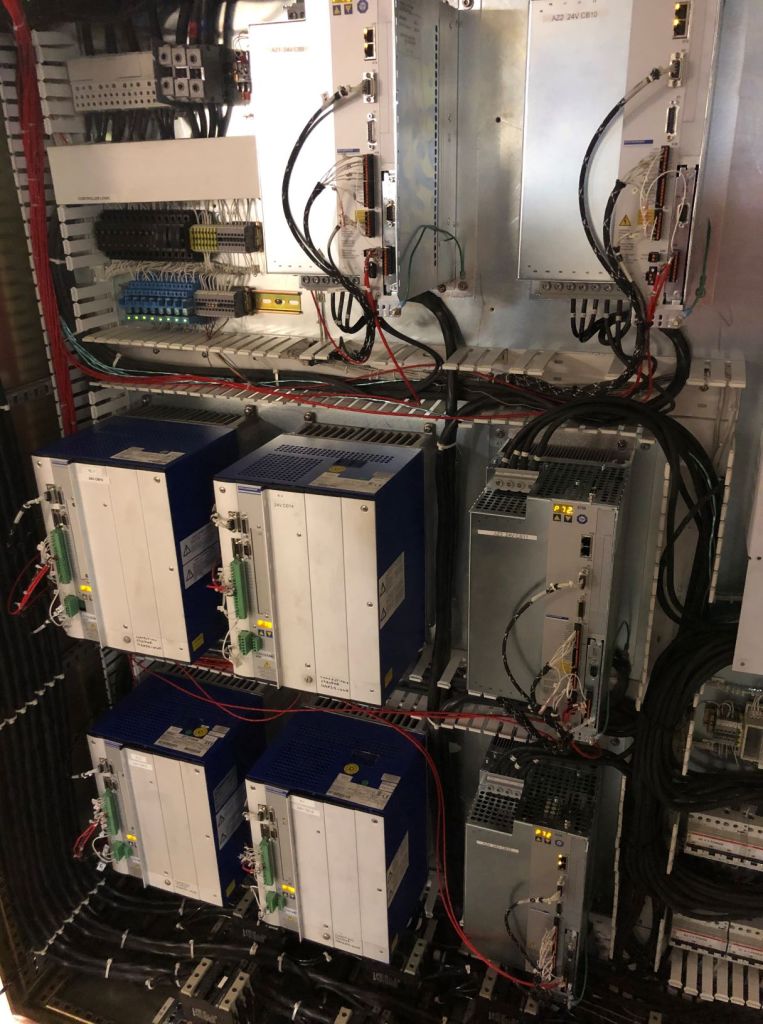
Similarly, the telescope drive system is located in the control room below the telescope, and we need to monitor those systems for signs of distress. For example, last year one of the drive amplifiers had a bit of a melt-down and they had to replace one. So I’ve been all learned-up on how to replace drive amplifiers, and how to drive the telescope on single-motor operation if need be. The telescope actually has 8 motors; 4 for Azimuth, and 4 for Elevation. The reason being that on each side, there is a set of two motors which are nominally driven with a slight torque against one another. This prevents backlash in the gears when changing direction (backlash occurs in gears because there is some space between gear teeth, and if you’re driving in one direction you push against one side of the gear tooth, but when you change direction there is a bit of space in between the next tooth).
The 8 drive amplifiers for the 8 motors, located in the control room below the telescope. Each amplifier supplies it’s motor with 72 amps! That’s a lot of power (your entire house probably has a circuit breaker set at a max of 15 amps)! One of these blew last year, so I have been trained on how to replace and calibrate one (or multiple) if need be.
One final thing we had to do was to recharge the helium compressor for the optics section of our receiver. Since we observe faint microwave signals from the 2.7K background, our detectors need to be extremely cold. Similarly, anything that is warm will emit microwave radiation in the frequency range we measure. Therefore, we need to cool our lenses and filters down as much as feasible. Since our camera is so large, we use two refrigerators to cool it down, one for the optics (lenses, filters, etc) and one for the detectors (and cold readout electronics, etc.).
These refrigerators work by some thermodynamic magic and use high pressure helium to do it. I wont pretend to understand how they work, nor to bore you with the details, but basically these fridges run optimally when they contain compressed helium at 320psi. Last winter, a known leak in the optics compressor meant that they had to recharge the compressor back to 320psi weekly. As the helium leaked out, and the pressure went down, the performance of the fridge suffered. The leak was found this past week, so we needed to recharge the helium back up to nominal 320psi so we could look for stability and hopefully get our fridge nice and cold.
Recharging the optics compressor. These compressors need ultra-high purity helium, so we need to pump out all of the air in the line before adding the helium. We then pump and purge a few times to make sure we’ve got all other elements out of the line before adding the optimal pressure. These compressors are also very touchy about how fast you fill them, if you add more than about 1psi/min, that can force oil out of places… or something. So we carefully open the needle valve into the compressor while monitoring the high-pressure (you can see the computer screen in the distance).
Monitoring the compressor’s high-pressure values. The red line at the top is the detector compressor (already at optimal 320psi), and the white line is the high-pressure reading on the optics compressor, so you can see we’re slowly adding helium and increasing the pressure.
Very exciting stuff!
I also learned about greasing. Looks like weekly and biweekly greasing will need to take place… I will be sure to get some pictures of that!
After the morning of doing rounds, and preventative maintenance checks, we decided to go back out to the berms to check out some SPT cargo boxes which had apparently broken open. So I got to zip around on a snowmobile again which was fun. It was so warm and so not windy that we ended up getting super hot while moving crates, and cleaning up the mess of steel plates, Teflon pads and other random hardware bits and pieces. I was out there in only a light puffer jacket and sunglasses and stayed relatively warm.
After that, I decided to go for a little run and bring my faux-pro (lol- I’m so clever…it’s an off-brand go pro)… I tried to give a little tour of the Dark Sector, but I need to find a way to reduce the video jitter since I’m running… otherwise you’ll never be able to watch it.











 Allen's South Pole Winter-Over 2020 (+)