June 19th – Day 169 on Ice

Weather: We got below -90F last week, but with high winds (gusting up to about 40mph) blowing in recently we’ve warmed up and reduced visibility greatly. Currently only around -60F, with windchill down near -100F.

I haven’t posted in a while, due in part to the internet being up early (currently up from 4:45 AM until about 10AM) , but mostly out of sheer laziness.

We have our mid-winter dinner on Saturday. Mid-winter is June 21st, which signifies 3 months since the sun went down, and 3 months until it comes up again on Sept. 21st! This is apparently a ‘big milestone’ according to our station manager, though it feels like it went by in a flash! And anyway, once you’re left here on Feb 15th, what else can you do but make it through? There’s nowhere to go! 🙂

It’s pretty surreal that we only have 3 months of sun-less sky left. Every time I walk out to the telescope on a clear day it feel surreal. Life here is a complete separation from the real world, especially during this special year ya’ll northerners have been having!

With mid-winter celebrations comes the annual viewing of ‘The Shining’, and this year the new sequel ‘Dr Sleep’. We also have a nice formal dinner, which I am more than excited for! Given how fantastic the sunset dinner was, I have high expectations for this meal… and I’m sure our Galley staff will not disappoint!

On a separate note, I’ve been running more and more, following a marathon training schedule that is probably useless now since it doesn’t seem like I will be able to travel in NZ after I get off ice. I hit 50 miles last week. Treadmill running still sucks, but it’s getting better.

We also got some updated news on this year’s redeployment (i.e. leaving the ice). It looks like there will be a very small summer crew (basically next year’s winter-overs + some extra maintenance crew). There will be no LC-130s (the cargo planes) but instead will be only 2 flight windows to get in/out of Pole, and these will be on DC-10s (also called Baslers). The windows are Nov4-28 and Jan27-Feb14, in each of which there will be 9 scheduled Basler flights. Baslers can hold 14 pax on the way to Pole but only 5 out of Pole because of the take-off altitude.

This makes things like Winter-over turnover, summer maintenance, cargo shipping , etc quite difficult and results in an unprecedented summer season for South Pole (and likely for the rest of the USAP as well). Things remain in flux, of course, as COVID progresses up north and will likely change (though I don’t know how) by Fall.

Anyway, enjoy the Summer Solstice up north! I will be enjoying mid-winter dinner and the shortest day of the year in the southern hemisphere… just kidding it’s a 6 month night here every year!

Happy Mid-Winter!

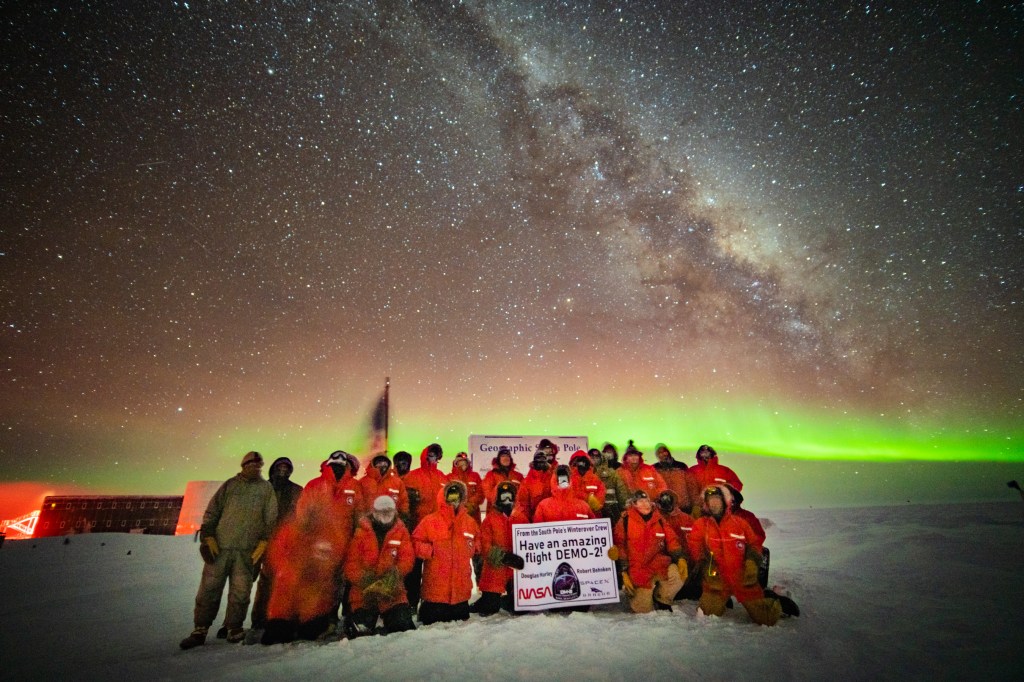
Our totally not photo-shopped mid-winter picture. Each antarctic research station sends out one of these cards to each other during midwinter.

June 01 – Day 151 on Ice

Weather: It has been oddly warm for the past few days. Temperatures up near -35F, with winds 15-20mph. With the wind came clouds and warmer temperatures. The moon is supposed to rise today, though the visibility is so poor that we can’t see it yet. Hopefully the clouds clear soon and the cold weather comes back!

This past week was busy (as each week seems to be… though I don’t know what I actually get done). I had another Astronomy lecture on Sunday, this one about massive star core collapse supernovae, type 1a supernovae (which occur after accretion of mass onto a white dwarf), and black holes. I tried to introduce general relativity in a few slides… not sure I succeeded :).

I ran 42 miles on the treadmill this week as per my training schedule. I still hate running on the treadmill but it seems to go by pretty fast while watching Seinfeld. I haven’t run beercans in probably a month, so I’m getting close to 200 behind where I should be. I also haven’t gone out to the climbing gym in nearly a month… it just takes a while to suit up and go out and come back, and I’ve been concentrating mostly on running which takes quite a few hours each week.

Seems like I don’t ever have the attention span to get work done here. I’m pretty tired all of the time so things that take brain power (like my data analysis projects) are suffering. Currently I’m looking again at the polarization calibration stuff, and trying to get it in a finalized form for a paper that is being written about the state of the telescope instrumentation.

Mid-winter is in only 3 weeks! After that it’s only 3 months until the sun comes back up! So far the time has flown by, and I’ve enjoyed my time here (especially since the world is falling apart this year). Hopefully the next few months go by just as smoothly!

May 23rd – Day 143 on Ice

Weather: With the moon down, we are in full astronomical darkness. The weather for the past few days has been very clear, calm and cold. The milky way is visible in it’s full glory and auroras have been really intense. Temperatures have been consistently below -80F and winds around 10mph.

Yesterday, I laid down on the ice for about 10minutes and just stared up at the stars. It’s incredible to see not only the stars, and the enhanced brightness of the galactic plane, but also the dark regions which are obscured by dust — something I have never seen with my own eyes! It was also awesome to see the Large and Small Magellanic Clouds (which are dwarf galaxies that orbit the Milky-Way)… the names now make sense, as they look like clouds to the naked eye.

Yesterday, we wished NASA, SpaceX and the flight crew the best of luck in the upcoming launch. The launch, taking astronauts to the ISS and scheduled for May 27th, will be the first crew launch from US soil since 2011! Can you spot me?! (I’m the person in the far back right). PHOTO CRED: Geoff Chen

Since I don’t have a nice camera for taking aurora photos, or timelapses, I decided to scrape the live feed cameras and save images to make my own timelapse. These cameras are high gain (and high noise) but we had some amazing auroras yesterday which I captured and put into the timelapse below.

NOAA webcam looking at the station

Station webcam, looking at DSL

The NOAA webcam is much nicer than the station one, and so the stars pop out much nicer. The bright star you can see moving across the screen is Sirius. Auroras begin to explode in the NOAA cam around 11:30 and the green light can be seen in the DSL cam. These timelapses were constructed using pictures taken in 5s intervals. The speed is a few minutes per second, which is a little too fast to see the SPT scanning cleanly, but better for seeing the celestial rotation.

This weekend is a 2day weekend for the contractors, which means lots of activities going on, mostly movies. On Sunday we have a very special double feature of Frozen and Frozen 2! On Monday we have a plan to watch Space Jam, and then play basketball with the hoops dropped down to 8ft! I’ll finally be able to touch rim… and maybe dunk!

Next week I have a scheduled call with my high school physics teacher and the school’s chapter of the Science National Honor Society to talk about my work at the South Pole and how I got here. I also need to present some work on the polarization calibration analysis I’ve been doing at the SPT3G collaboration’s analysis meeting. My astronomy lecture is pushed back a week since this weekend is so full of events ( and I haven’t started writing the next lecture anyway, which will be on stellar deaths, supernovae, pulsars, and black holes), so I’ll have to do that next week as well… another week of not getting enough work done. Such is life.

Cheers!

May 18th – Day 138 on Ice

Weather: There has been some overcast and generally high winds recently. The moon is waning so it’s been quite dark outside, but we haven’t had many clear days to see stars or aurora. With the slight cloud cover the temperatures have been relatively warm, between -45 and -50C.

Not much of note has happened in the past few days. The power plant thinks they’ve solved the problem that caused the brownout a few days ago, so they’re running some tests during the SPT downtime. If these tests are uneventful, they’ll call the problem solved and we’ll move back to full time observing with no interruptions.

We had a karaoke night this past weekend, which was…. interesting 🙂 . There was one person in particular who had a wonderful (and unexpected) twangy country voice! I basically lost my voice on the first song and sucked at everything else I attempted 😛

I gave my astronomy lecture on Sunday, this one was about stellar formation and evolution, mostly sun-like stars. Massive stars, supernovae and black holes will have to wait until next week.

We’re planning another movie trilogy marathon for this week. Probably will watch The Matrix trilogy. I’ve been doing more running (following a marathon training schedule), but I have been slacking on lifting, running beer cans, and going to the climbing gym… there just ain’t enough hours in the day! We’ve also been doing 2 nights of volleyball per week, each night usually lasts 3 hours.

May 10th – Day 130 on Ice

Weather: This past week we had some poor weather with high winds, which has since cleared up to clear, cold, calm conditions. Currently it’s -63C with 4m/s winds (that’s about -82F with windchills below -100F). The met weather station is currently borked after a software update, but we have the weather data from the top of the SPT building.

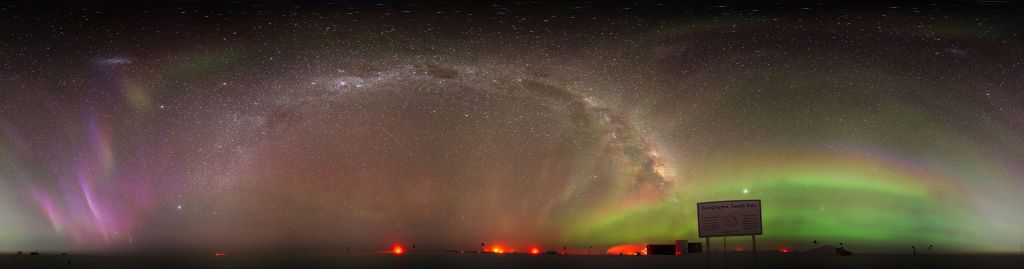
Here is a panorama from Geoff (the other SPT winterover) of the Milky Way over the station. I believe there were 8 photos, each taken with 30s exposure.

There has been a lot of talk between the photographers with the nice cameras, taking these beautiful, long exposure shots (and also the live-feed cameras which have super-high exposures), and the average Joes like me who use their cell phones for pictures. It’s much darker than you might think, and the smaller aperture cameras like my cell phone cannot capture everything like is seen in the photo above. Similarly the live-feed cameras make the moonlight appear like it’s a sunny summer day! The full moon definitely provides enough light to see where you’re going so you don’t trip over sastrugi, but it’s nothing like the cameras make it look!

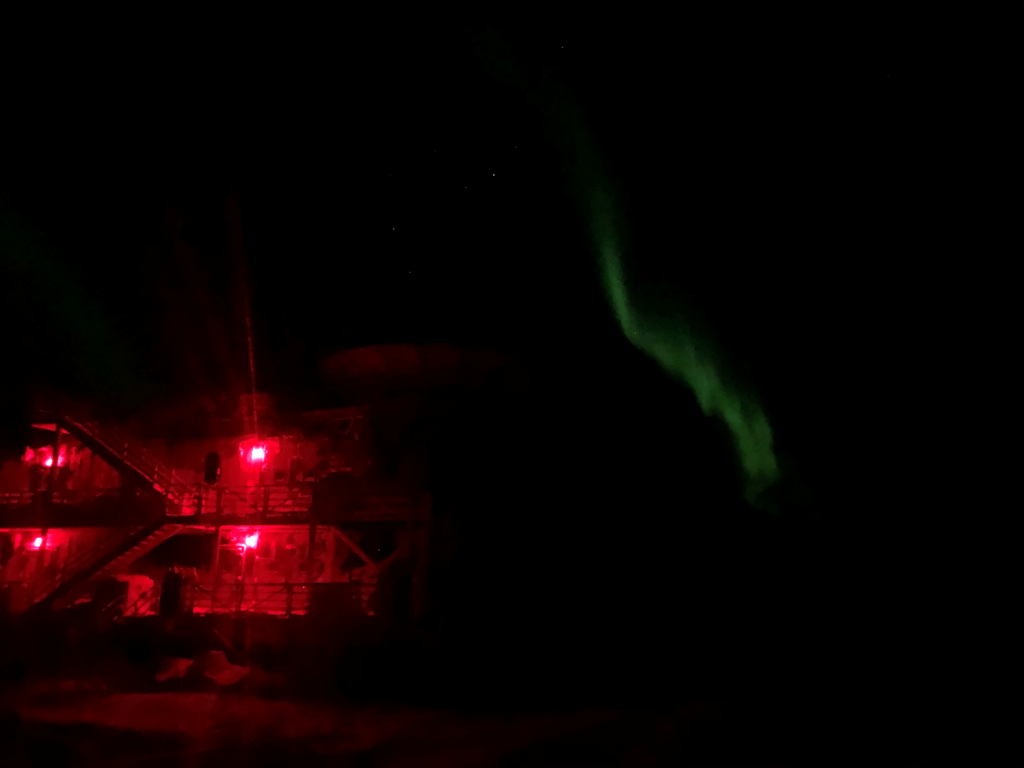
Check out my photos below for a more realistic view:

Aurora over DSL; a medium-brightness aurora, though not very extensive. You can barely make out stars. The eye has much better dynamic range, so you can see many more stars than this, and the aurora pops out a bit more, but for the most part (when the moon is down) this is what it looks like.
Full moon from the observation deck. The camera has a really hard time trying to figure out the large contrast between the moon and the darkness everywhere else. You can still make out the shadow of SPT, and see structure in the snow.

I apologize for the infrequent postings. The internet is now up from 0730 until around noon, which is my ideal work time so I have been putting off the blogging. I’ve also not had many good pictures since the weather has been crappy.

We’ve also been dealing with some power plant issues; we had a few quick brownouts last week which has caused problems for SPT. It’s also caused them to try and figure out the cause of the brownouts which means that they’re doing lots of tests on the generators for which we have decided to park the telescope (so as to not be moving in the case of a power loss).

As far as science goes, I’ve been spending a lot of time analyzing the variability of bright sources in our field maps. These Active Galactic Nuclei, or AGN, can vary greatly in brightness on various timescales because of dynamic processes around the central supermassive black holes of galaxies. Depending on the size of the black hole, you might expect variations to take longer or happen quicker (because light can only propagate at a certain speed, i.e. for very large black holes, you wouldn’t expect very fast changes in brightness). Even the largest of these AGN are still just point sources to us, so we can’t resolve the physical scale, but perhaps some analysis of the variability can give us some more information. Similarly, looking at SPT data and comparing that with other wavelengths can yield even more information about a source. Experiments such as the Fermi gamma ray telescope monitors such sources for ‘flares’ in their brightness, and we’ve just begin to consider correlations and time lags between our data and theirs.

90GHz flux of a certain, very bright AGN in our field map. For each observation I cut out a small region around the source and calculate the brightness of the source, as well as the noise in the map (shown as an error bar here). The orange points come from a different set of higher-resolution observations. The gap in data is due to our Summer field observing, which did not view the source shown here. The timescale here is approximately 1.25 years, in the arbitrary G3 time units that we use.

May 03 – Day 123 on Ice

Weather: The weather has been crap most of the past week. Highly variable cloud coverage and high winds made for poor data quality as well as poor visibility. Today the weather has cleared and winds dropped. With the clearing clouds, temperatures have dropped nearly 20C, down to -60C with winds subsiding to 10 knots. We broke 2 wind speed records last month – 39 and 44 mph gusts on the 28th and 30th respectively!

I have been extremely busy the past few days. An interesting plot I had made a few months ago has been dug up and stirred up some interest with the point-source folks. The gist is that I was looking at the brightness of point sources over time (since we look at the same region of the sky over and over, we get a measurement of the brightness of the sources in that field each time). There was apparently a source which shows a high degree of flaring in the Fermi (gamma-ray telescope) data over the last year, and which is also in our field. Not much is known about the mechanism which energizes the source, so it’s helpful to measure the energy over a broad range of wavelengths… SPT observes at wavelengths of 1 mm, so it’s very different from the high-energy gamma rays measured by Fermi.

I’ve also been trying to update some code which allows us to calibrate our pointing offsets in post-processing of field scans… essentially looking at the locations of point sources in our maps and finding the deviation from their known locations, then applying a correction before making the full field maps. This needs updating to more heavily filter the atmospheric noise (since the weather has been really bad recently, it’s become clear that we need to remove as much atmosphere as possible).

I’ve also been trying to write a reasonably intelligent astronomy lecture about the formation and evolution of the solar system… which I gave this evening, and probably failed to sound interested or intelligent (I don’t particularly care about our solar system). We also had a small hiccup in our power plant last night, cause a brief brownout. This meant that we had to go out to the telescope and make sure all systems were operating correctly, and get the data collection back on track… I haven’t even run or gone to the gym in like 3 days! There are just not enough hours in the day!

I feel a weight lifted off my shoulders after giving the lecture, even though I don’t think it was particularly interesting. Now I can focus on making a presentation for Tuesday’s analysis telecon about point source fluxes, trying to get a better offline-pointing model analysis running, and figuring out what to do with my measured polarization leakage (that I found like 2 weeks ago but haven’t done anything with), and not slacking on my exercise… well on the bright side, Saturday’s dinner was surf and turf — beef tenderloin, and shrimp with asparagus and RedLobster-style cheddar biscuits!!

April 28th – Day 118 on Ice

Weather: The temps have warmed greatly in the past 3 days; we’re up near -40F !! Winds are moderate so windchills still down near -70F.

Yesterday Zach, Nathan and I watched the Indiana Jones trilogy while run/walking on the treadmill. I got 24 miles in in the ~6 hours of the movie, doing .5miles walking and .5miles running on and off.

No other pictures since the weather has been rather cloudy (hence the warmer temps).

I gave my 2nd astronomy lecture on Sunday evening which was about the fundamentals of observing astrophysical objects including using spectra to measure temperatures, using Doppler shifts to measure distances and even a bit about multimessenger astronomy. With my next lecture being next weekend, I need to get started writing it up soon! It seems to take a long time for me to write lectures… even when half of the material is already there from previous years!

That’s all for now!

Cheers

April 25th – Day 115 on Ice

Weather: The winds subsided and skies cleared for a two days allowing for some great aurora viewing. We’re now back to high winds around 20mph and temperatures climbing to -70F as the turbulence mixes warmer air from higher in the atmosphere.

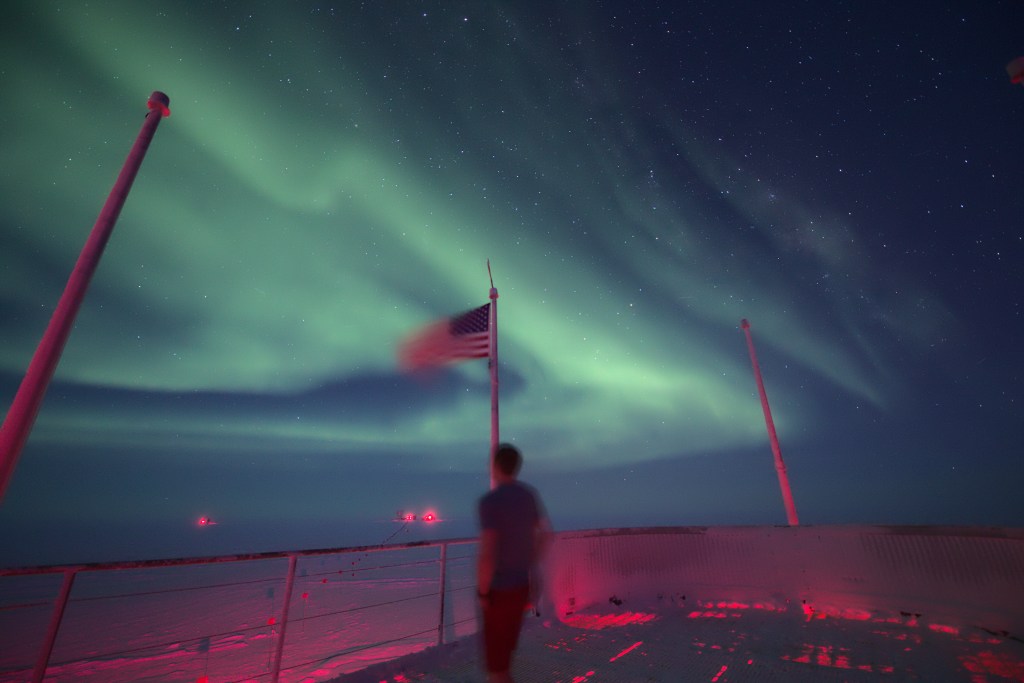
Me standing under a full sky of auroras after running in the gym (in shorts and t-shirt). Temperatures were below -80F, but low winds made standing outside tolerable… at least long enough to get this 10s exposure! Photo Credit: Zach Tejral

The above photo is a 10s exposure of some particularly extensive auroras over the Dark Sector. The auroras weren’t exceptionally bright at the time of this photo, but they did have a large extent, covering most of the sky for quite some time… It’s nice to have people around with nice cameras to take pictures for you 😛 Thanks Zach for the photo!

Weather has gone back to windy so it may be another few days before it’s nice enough to star-gaze but we’re now in Astronomical Twilight, for the next two weeks or so as the light from the sun slowly fades completely and the darkness increases.

Short post for today… back to writing my next astronomy lecture – this one is about fundamentals of astronomical measurements, including what electromagnetic radiation is, how we measure distances, temperatures, energies, etc.

April 23rd – Day 113 on Ice

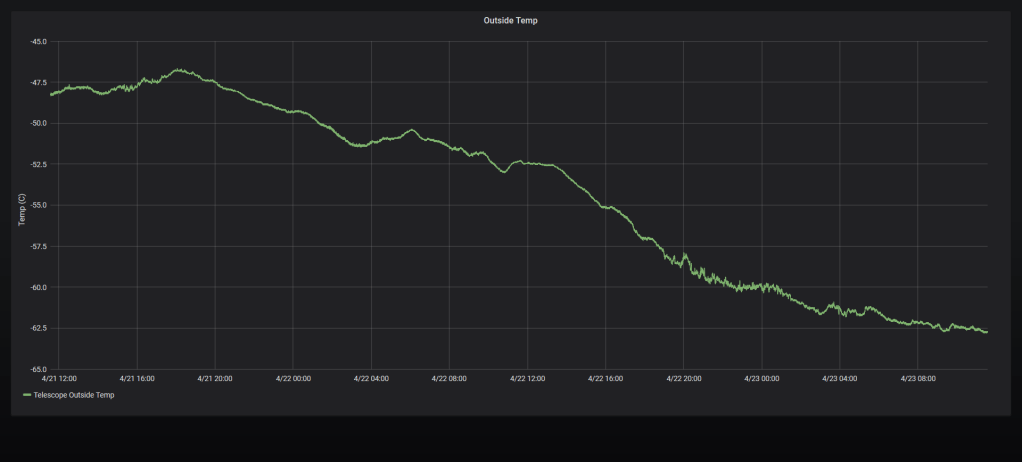
Weather: Temperatures have dropped almost 20C in the past two days as the clouds have cleared and wind has subsided (see image below). We’re now around -60C (-80F) with winds around 10mph.

Temperatures over the past 2 days… we’ve dropped from -46C to -62.5C (-50F to -81F)! Though with winds nearing 40mph a few days ago, the lighter 10mph winds and colder temps have a similarly cold windchill.

It has gotten quite dark outside with the setting of the Moon, although there is still some visible Sunlight on the horizon when conditions are clear. I’m starting to wish I had bought a nice camera.. my phone and small faux-pro are helpless in these light conditions (not to mention they die after a few mins in the cold). The Milky Way was pretty clear today as well as some faint auroras which look basically like whispy green clouds stretching across the sky. A long-exposure photo would have made for a beautiful shot.

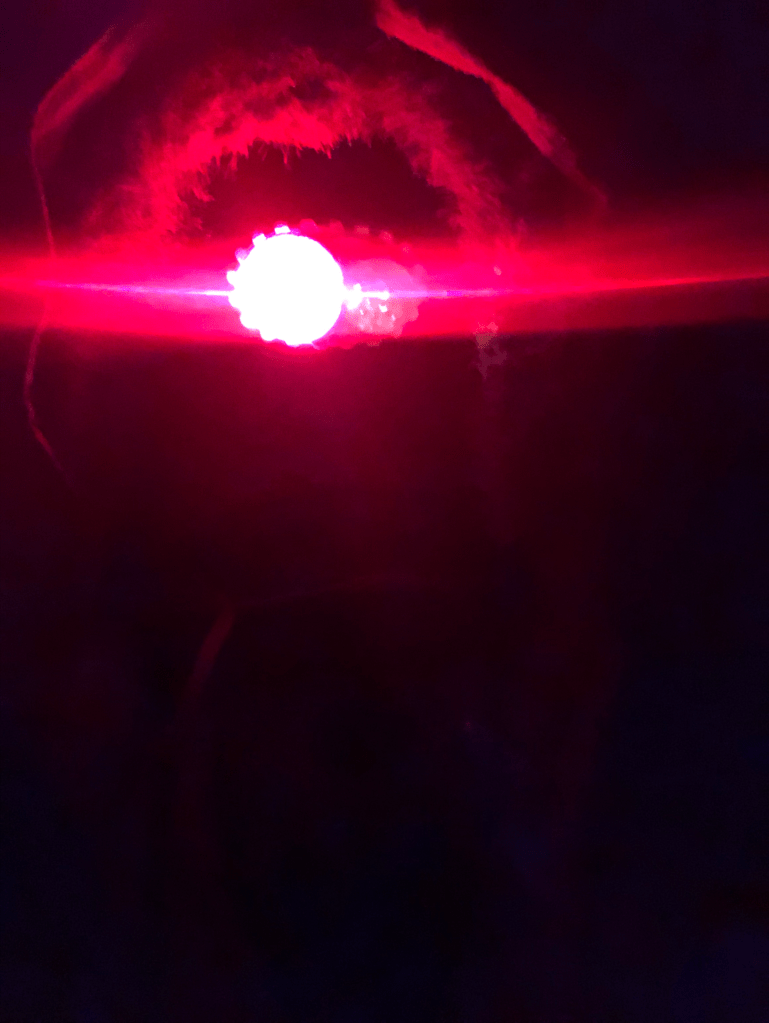
My fancy shmancy headlamp; colored red to allow the aurora camera experiments to operate without being blasted by white-light headlamp noise… The soft red light allows you to see a tiny region in front of you, so you don’t trip quite as easily on the sastrugi.

The winds were so calm this morning that I even decided to go for a little run outside, though after about 20 mins the winds started to pick up so I only got about 2 miles in.

I have attempted to take video showing what it’s like to walk outside with the headlamps, though even they didn’t come out well, showing only black and a small red dot… but that was last week with 30mph+ winds and low visibility. Maybe I’ll try again in better weather soon (though winds are expected to pick up again after tomorrow).

In other news, I finished the route I had been working on in the climbing gym! woohoo! and even made a lovely video with an awesome soundtrack if I do say so myself! 🙂

April 21st – Day 111 on Ice

Weather: It has been really windy and relatively warm for the past week. Average winds have been around 20-30mph for the day with gusts up to 40mph. Temperatures have been hanging above -60F for the most part but with the high winds it’s been below -100F windchill.

With the increased winds, there has been a lot of blowing snow so unfortunately I can’t really get any good pictures of anything. The moon is waning and also getting ready to set so it’s getting darker! Walking out to the telescope is pretty awesome in high winds and blowing snow and I can barely see one flag ahead of me. I need to use my red headlamp now, but even with that it’s really difficult to see the drifting snow and sastrugi which make for great tripping hazards. I feel like a drunkard stumbling around out there.

This past weekend was a 2 day weekend for the contractors, which means that there are a lot more social events than usual. One of the fun events was on Monday we watched The Sandlot, and then played wiffle ball afterwards!

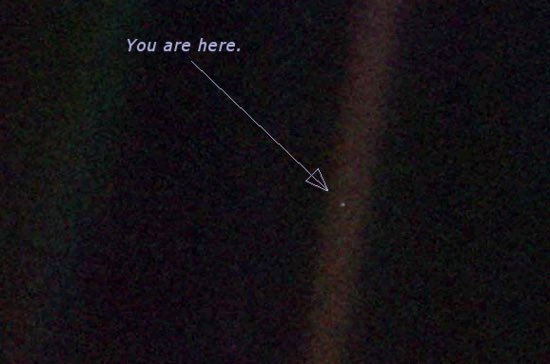
I also taught my first lecture of my Astronomy and Cosmology course on Sunday evening. The topic was a bit metaphysical, and I called it ‘The Cosmic Perspective’ which was just describing the size and age of the universe and how insignificant the Earth is and how short-lived all of human civilization has been compared with cosmological processes (for example the Milky Way rotates only once in 270 million years). Next week we’ll discuss physics and astronomical measurements and how we actually observe astronomical objects and measure things like distances, size, etc.

Earth in a Sunbeam: image taken by Voyager 1 as it passed the orbit of Saturn… Part of my lecture included trying to understand how insignificant we are.

I’ve also been chugging away at this one route in the climbing gym, and have almost fully completed it (I’ve completed each move, but haven’t done it all together). I’ve been filming my failures so hopefully soon I’ll have a whole progression to show culminating in me actually completing the entire route in one go.

Other than that, I’ve been getting more comfortable running on the treadmill (though it still sucks!). We’ve been discussing doing another movie trilogy walk, perhaps Indiana Jones this time? Maybe Back to the Future? something… but something not quite as long as the LOTR!

Work has been slow (in a good way) due to the cooperation of the telescope. We haven’t been woken up in the middle of the night in a while! My analysis has slowed down as I’ve been writing my lectures and exercising frequently and playing sports in the evenings and trying to get some reasonable amount of sleep. Currently I’m working on understanding what the magnitude of the leakage of temperature into polarization is for our different detectors. One of the major purposes of the telescope is to measure the polarization of the CMB, which has a much much smaller signal than the temperature (or total intensity). So it’s good to know for sure that you don’t have some T signal leaking into the polarization, or P, signal… and if you do it’s really good to know exactly what that leakage looks like!

The food is still great!

Cheers,

Allen

Design a site like this with WordPress.com
Get started