Weather: Still cloudy and windy with low vis. The temps have been dropping a bit as the cloud layer thins out, but it’s still only about -40F. Winds up between 15-20mph. I should film myself walking outside the entrance to the station sometime in high winds… the wind really whips around the sides of the station.

Not much has changed since yesterday. We had our weekly update telecon with the North this morning.
I’ve started getting back into my polarization calibration analysis that I’ve been working on (on and off) for about 2 years now. There is a big interest from the upcoming generation 4 series of CMB telescopes because they want to understand the polarization response and efficiency and systematics, etc, of the style of antenna that SPT3G uses.
The difficulty with such a large, high angular resolution camera as SPT3G is that in order to do such optical calibrations, you need to be in the ‘far field’ such that the electric field of incoming (or outgoing, if you prefer the time-reversed field-of-thought) light is negligibly changing. Basically, you want flat, plane-waves arriving at your detector. For us to do that we need a source a few km away. This should be fine, since the South Pole is flat — we just drive out a few km, stick a source there, look at it, and boom Bob’s your uncle… Indeed that would work, but our detectors are so sensitive that if we look that close to the ground, the heat from the -50 degree ice would saturate all of our detectors and we would see nothing! So you might think, ok, just put the source up on a tower… Even if we only wanted to be 10 degrees off the horizon (which is still pretty low, I’m not sure we could even do that), that would mean we need a tower that is approximately 10% of the distance between the telescope and the tower; i.e. for a source 5km away we would need a 1/2 km high (or 1/4 mile high) tower! That’s unfortunately not feasible.
What we’ve decided to do is use a cosmic source of polarization; something that is definitely in our far-field! Centaurus A is a galaxy with an active galactic nucleus (AGN) which is spitting out two gigantic radio lobes. These lobes happen to be partially polarized in our observing frequency range (about 10-20% polarized in some parts of the lobes), which means that we should be able to measure the brightness change on the order of 10-20% depending on the angle of our detectors’ antennae.
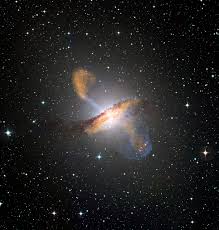
At longer wavelengths, the dust you see in the image above (around the nucleus) becomes transparent, so for SPT3G, we observe at about 1mm wavelength, so the dust all but disappears. The radio lobes are generated from electrons which are ejected from the nuclear region and spun around magnetic field lines, producing radiation called synchrotron radiation (accelerating electric charges produce electric+magnetic fields i.e. light).
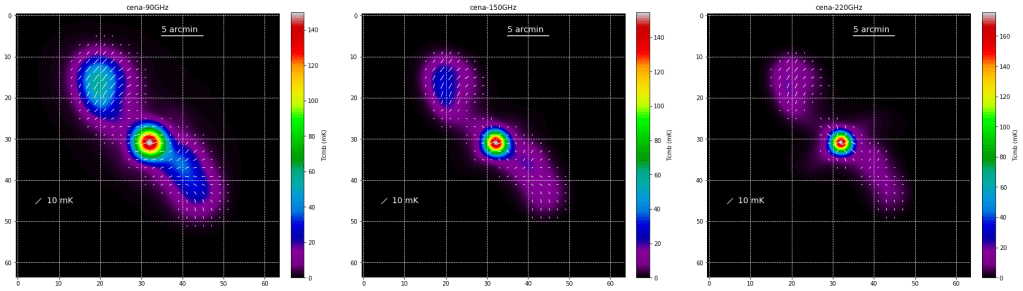
The difficulty here is that the radio lobes of CenA aren’t actually very bright, in an absolute sense. The plots above are maps made by adding up all 10,000+ detector maps for many observations. If I were to show you a single detector map (for which we care about measuring the polarization angle), for a single observation, you might think I were crazy for trying! The nice thing about the radio lobes is that they are physically large (so there can’t be short-timescale changes; this is not true for the nuclear region where the AGN is devouring dust, and who knows what else!), and also angularly large (large enough to be ‘beam-filling’, i.e. that a single detector’s beam will be fully contained within the lobe as we scan over it).
Anyway, I’ve lost track of what I was talking about… oh yea, measuring the polarization response of each detector…
Well it’s difficult, and we need many observations to build up the signal-to-noise per detector… but who is reading this blog that cares about this?? BOOORRING.
I need to take more pretty pictures…
 Allen's South Pole Winter-Over 2020 (+)
your family of course, glazed over. Good luck with your peer conversations. Love from earthlings
LikeLike